Profit From Coffee Shop
Learn how to improve profit from your coffee shop, from cutting costs and raising transaction value to adding zero-risk consignment retail with no inventory.
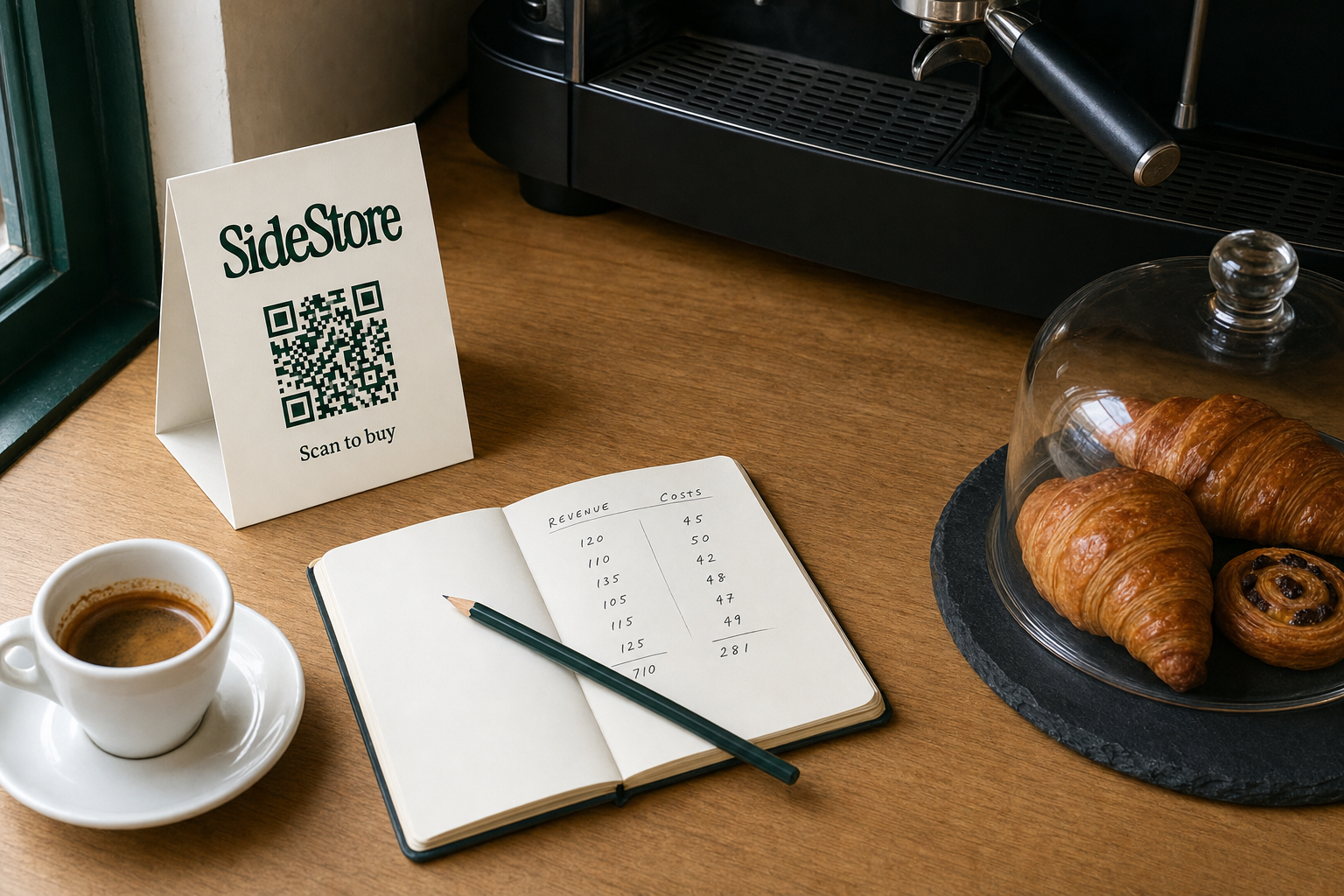
Profit from a coffee shop is the revenue left after covering all costs, including beans, milk, rent, labour, and overheads, and improving it means either reducing those costs, earning more per customer, or adding revenue streams that do not require proportionally more spend.
If your margins feel thin, you are not alone. Coffee shops carry some of the tightest margins in food and beverage retail. The good news is that several levers are available to you, and at least one of them, consignment retail, requires no capital at all. This article covers each lever plainly: what it is, what it costs, and what it realistically delivers. You will also find a comparison table of retail revenue models and a step-by-step guide to activating consignment shelf space in your cafe.
For a fuller picture of what happens when idle shelf space starts earning, see how cafes can make money from unused shelf space and coffee retail shop.
Understanding Coffee Shop Profit Margins
A coffee shop typically runs on net profit margins that industry estimates suggest sit somewhere between 2.5% and 15%, depending on format, location, and how well costs are controlled. A sit-down neighbourhood cafe trends toward the lower end; a compact, high-volume takeaway operation can push higher. The spread is wide, and the difference usually comes down to occupancy costs and labour.
Understanding your own margin starts with separating your cost structure into three buckets:
Cost of goods sold (COGS). This is the direct cost of everything in the cup: beans, milk, syrups, cups, lids. For espresso-based drinks, COGS tends to be low relative to the sale price, which is why coffee carries a high gross margin. The challenge is that this gross margin gets eaten by rent, wages, and equipment repayments before net profit appears.
Fixed costs. Rent and lease payments are the single biggest margin killer for most cafes. Unlike COGS, these do not scale down when trade is quiet. A slow Tuesday hits net profit hard.
Variable operating costs. Staff hours, utilities, and consumables move with trade, but not always efficiently. Over-staffing during slow periods is a common and correctable drain.
The gap between a 3% net margin and a 10% net margin is almost never about the price of a flat white. It is almost always about occupancy cost relative to revenue, and about whether the business is generating income from every square metre it pays for. That second point is where coffee shop profit margin analysis often reveals the most immediate opportunity, and why make money from unused shelf space is worth reading alongside any margin review.
How to Reduce Costs and Protect Your Margin
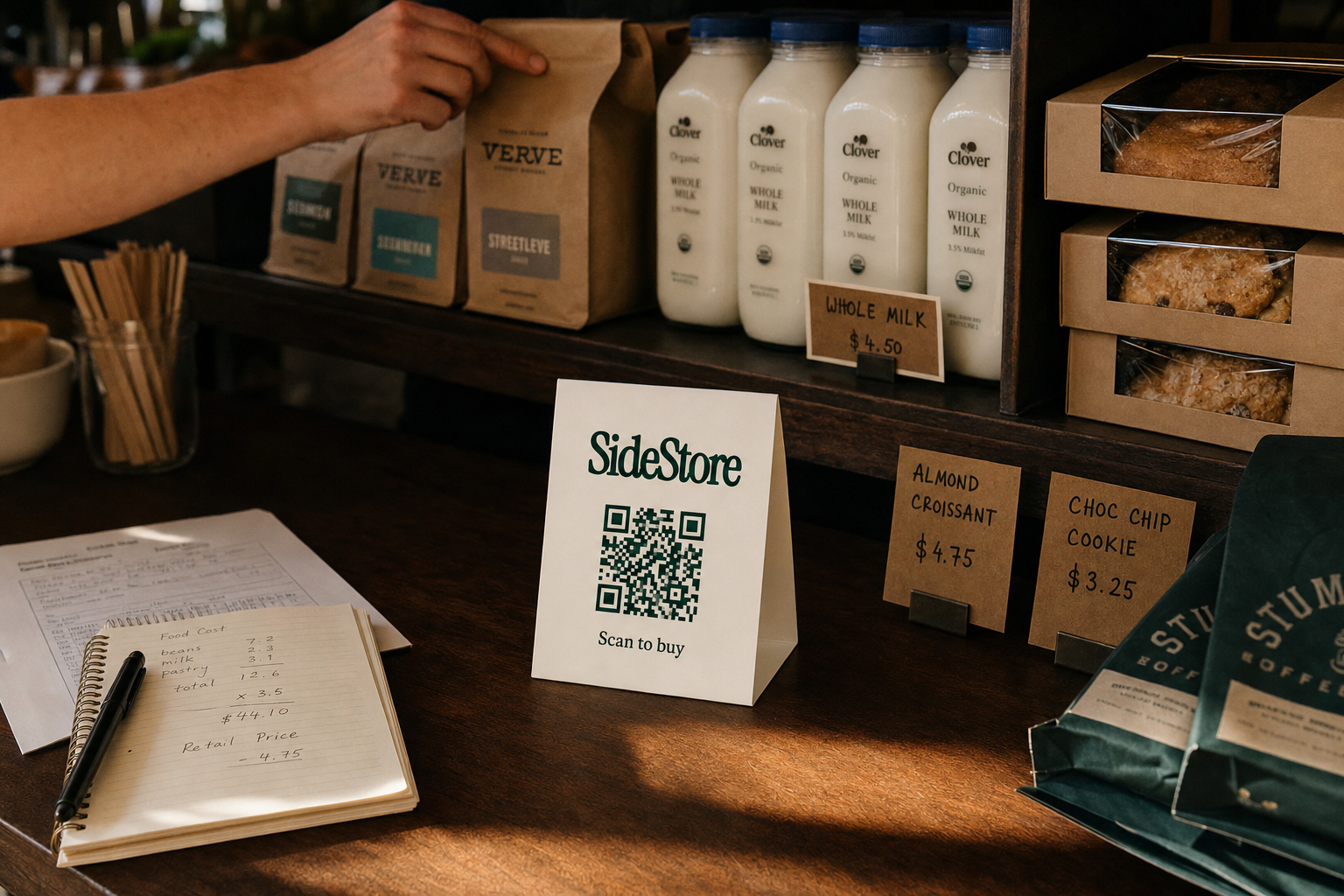
The first place to cut costs in a coffee shop is not your bean quality. It is the gap between what you pay for and what you actually use. Waste, over-ordering, and unoptimised staff scheduling are the three fastest routes to better margins, and none of them require you to touch your menu prices.
Audit your COGS weekly, not monthly. Monthly reviews obscure daily waste patterns. Track milk wastage, over-prepared batches, and shrinkage by shift. Small adjustments, such as calibrating pour sizes or switching to smaller default cup sizes for takeaway, accumulate over a week in ways that are genuinely visible.
Negotiate supplier terms, not just prices. Many independent cafes pay standard pricing because they have never asked for a volume review. Even a modest renegotiation on beans or disposables, justified by purchase history, can improve COGS percentage without touching the customer experience.
Schedule to trade, not to habit. Run a transaction-per-hour analysis across your week. If the data shows a consistent lull between 2pm and 4pm, staffing that window at full capacity is a direct margin drain. Adjust rosters to match real foot traffic patterns.
Renegotiate your rent at the earliest contractual opportunity. Rent is fixed in the short term, but lease renewals and break clauses are negotiating moments. If your landlord's alternative is an empty unit, you have more leverage than you might assume.
Reduce card processing costs. Payment processing fees compound quietly. Compare providers annually and consider whether a surcharge policy on small card transactions is appropriate for your market.
None of these require capital. They require discipline and regular review. Cost reduction is not a one-time exercise; it is a habit that compounds across years.
Increase Average Transaction Value Without Raising Prices
The most direct way to earn more per customer without raising prices is to increase the number of items in each transaction. This sounds obvious. It is also underexecuted in most cafes because the mechanics are inconsistent.
Train for verbal upsell at the point of order. A simple, specific question at the counter, such as "Would you like a slice of the banana loaf with that?" outperforms a passive menu display. The offer needs to feel natural, not scripted. Train staff to make one contextual suggestion per order, not a checklist of add-ons.
Anchor your most profitable items visually. Counter placement drives impulse decisions. High-margin items, whole beans, packaged goods, and baked goods with strong COGS ratios, should be at eye level and adjacent to the till. If a customer has to look for it, many will not bother.
Bundle strategically. A "coffee and cake" combo priced slightly below the sum of its parts increases transaction size and decreases menu friction. For example, as an illustration: if your average transaction is currently one drink at a given price, adding even one food item per three transactions meaningfully shifts your daily revenue without a single price increase.
Introduce loyalty mechanics that increase frequency and spend. A simple stamp card that rewards a free drink after a set number of visits encourages both return visits and slightly larger orders, because customers near a reward threshold tend to round up their order.
Consider retail products at the counter. A small display of local products can capture impulse purchases without requiring you to manage stock. This connects directly to the consignment model covered next, and to the broader idea of sharing retail space as a revenue lever.
Add a Retail Revenue Stream With Zero Inventory Risk
A cafe can add a retail revenue stream without buying any stock by hosting products on consignment: a maker places their products in your space, customers buy directly, and you receive a share of each sale automatically, with no upfront cost and no unsold inventory to absorb.
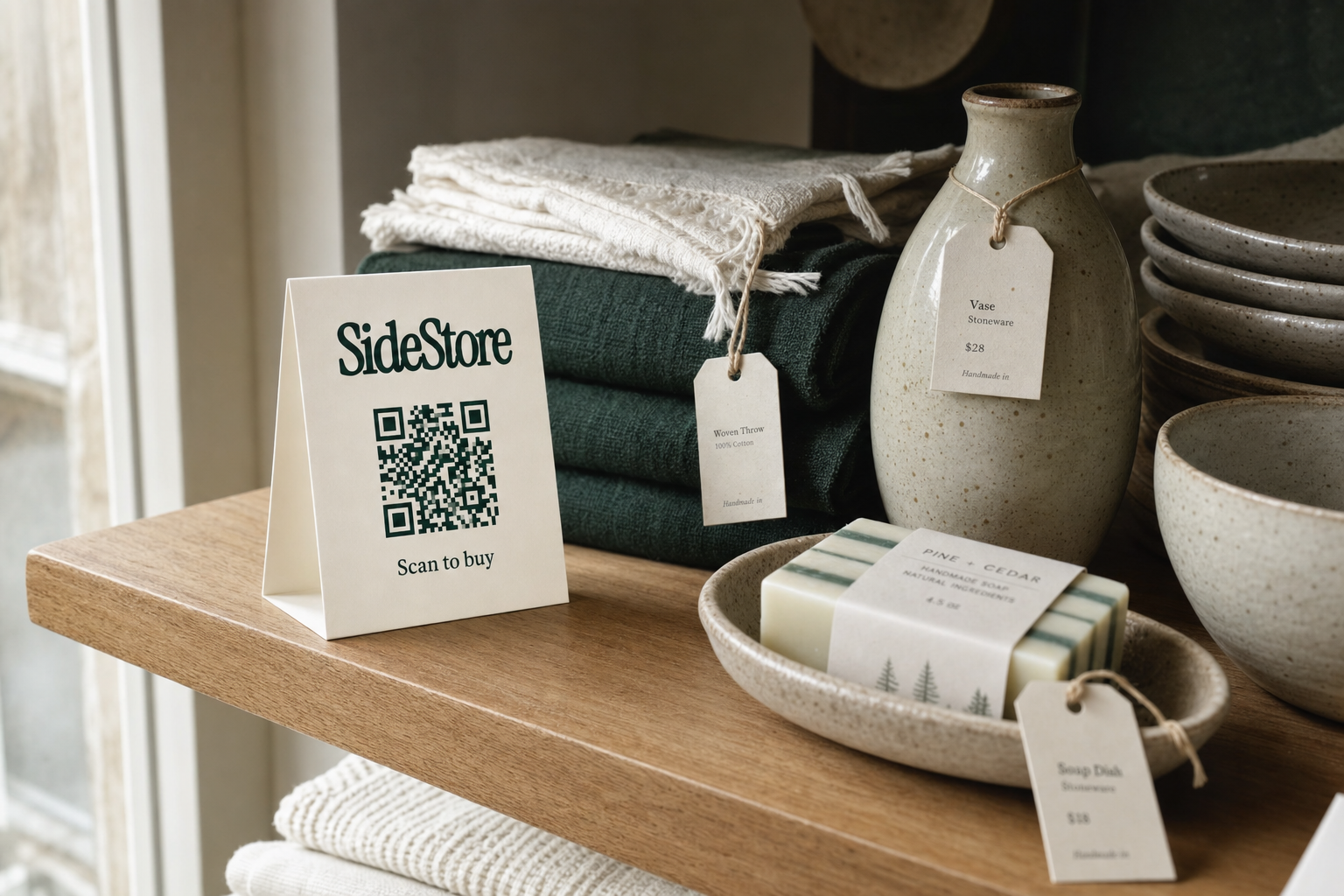
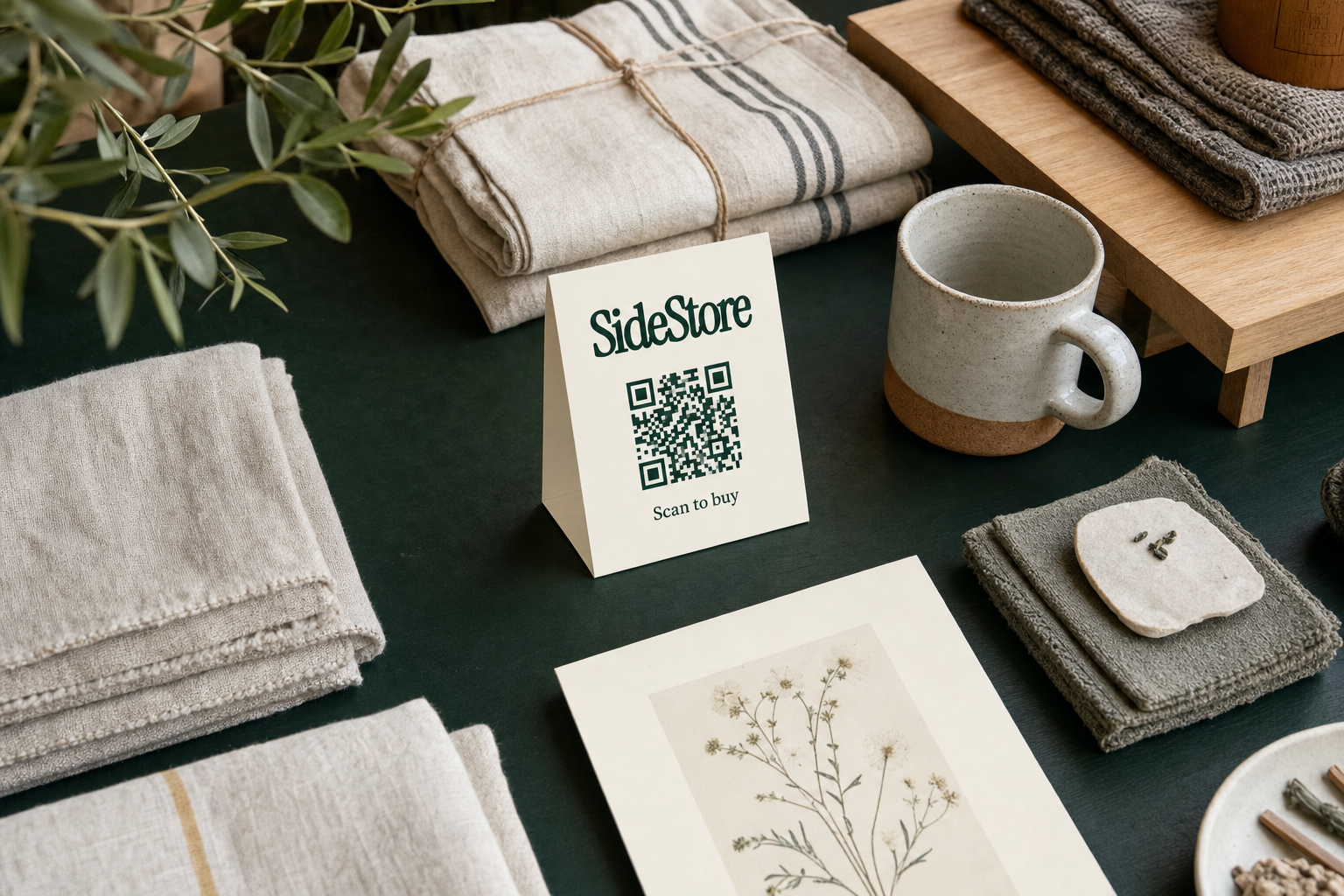
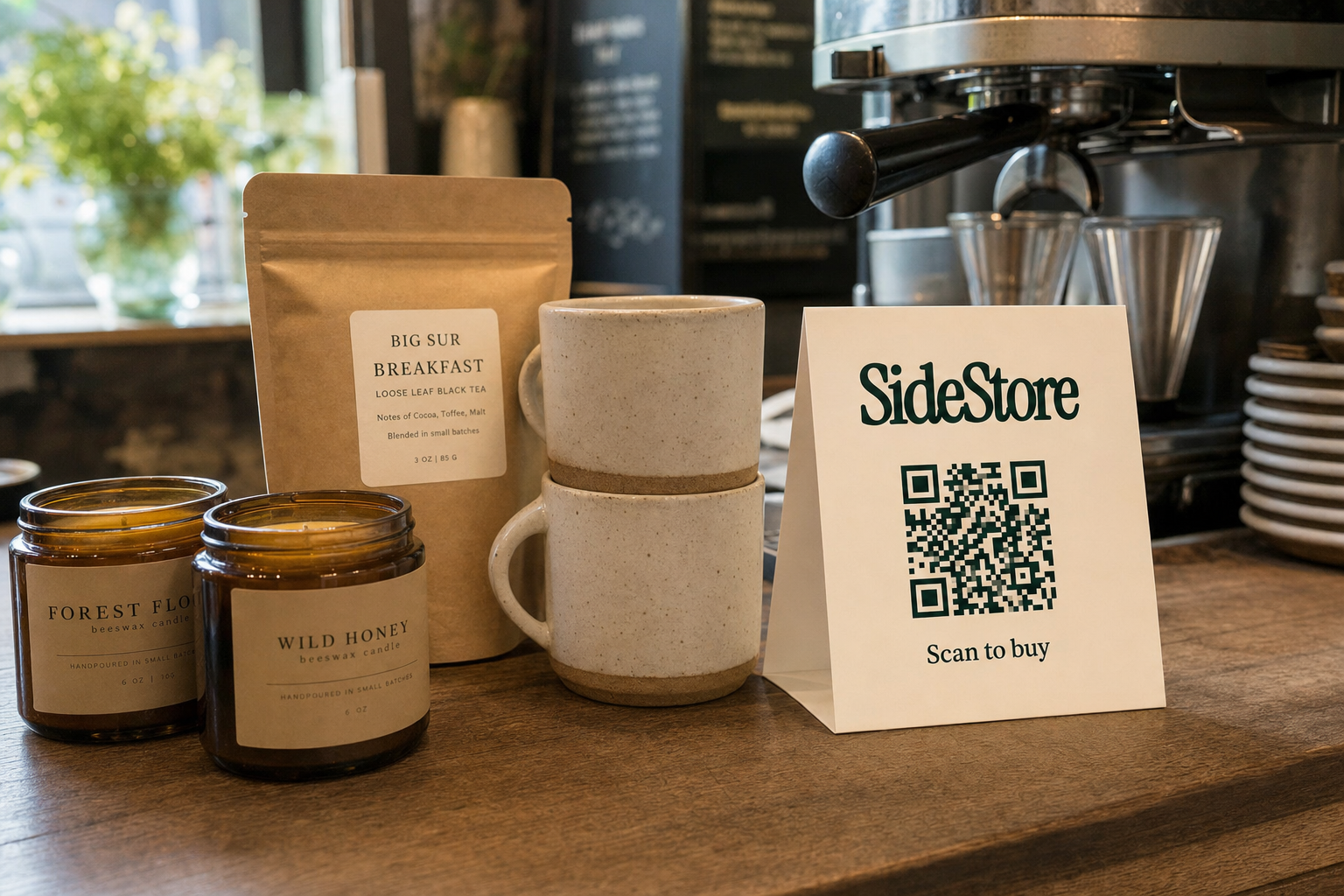
This is what SideStore is built for. The Retail Widget is the interface that places and manages a consignment product in your space from end to end. It handles checkout, live stock tracking, placement attribution, and automatic split payouts between the maker and your cafe. The QR checkout, a printable QR code card that customers scan to buy, is one function of the Retail Widget, not the whole product.
Here is what the mechanics look like in practice:
- A local maker sets up a placement in your cafe through SideStore and provides a printed QR card for their products (or a single card for the full placement).
- A customer sees the product on your counter, shelf, or display area, scans the QR code, and completes the purchase on their phone.
- The Retail Widget records the sale, deducts the maker's share and your host share, and settles both automatically.
- Stock levels update in real time. When the maker's stock runs low, they can replenish. You do not manage any of this.
Your exposure is zero. You provide shelf space that is already sitting empty. The maker provides the product, the pricing, and the stock. You earn a split payout on every sale that happens in your space.
For customers, the experience is frictionless. For you, it is a revenue line that did not exist before, with no purchasing decision required. See how the SideStore QR card works, how cafes can make money from unused shelf space, and selling on consignment for further detail on each part of this model.
Retail Revenue Models for Coffee Shops: A Comparison
The right retail model for a coffee shop depends on how much capital you want to commit and how much operational effort you can absorb. Consignment is not the only option, but it is the only one that carries no inventory risk.
| Model | Upfront Cost to Host | Stock Risk | Effort to Manage | When It Suits You |
|---|---|---|---|---|
| Buy-in retail (you purchase stock) | High | You bear all unsold stock risk | High: ordering, pricing, stock counts, markdowns | You have capital, buying expertise, and consistent sell-through confidence |
| Consignment (maker-placed, e.g. SideStore) | None | Maker bears all unsold stock risk | Low: provide space, Retail Widget handles checkout, payouts, and stock tracking | You have idle shelf space and want revenue without purchasing decisions |
| Shelf rental (charge a flat fee for space) | None | Maker bears all unsold stock risk | Low: collect rental income regardless of sales | You prefer predictable income over variable commission; maker takes all sales revenue |
| Pop-up or event retail | Moderate (setup costs) | Shared or maker-only, depending on terms | Medium: coordination, logistics, scheduling | You want periodic retail activation rather than a permanent display |
Consignment suits most cafes best because it aligns incentives: you earn more when the products sell well, so there is a natural reason to position them well. Buy-in retail can generate higher margins per unit but requires real capital, purchasing skill, and tolerance for slow-moving stock. Shelf rental is predictable but flat, and it gives you no upside if the products perform strongly. See boutique inventory for sale and how boutique shops can add local products without buying inventory for context on how other retail formats handle the same decision.
How to Activate Consignment Retail in Your Coffee Shop
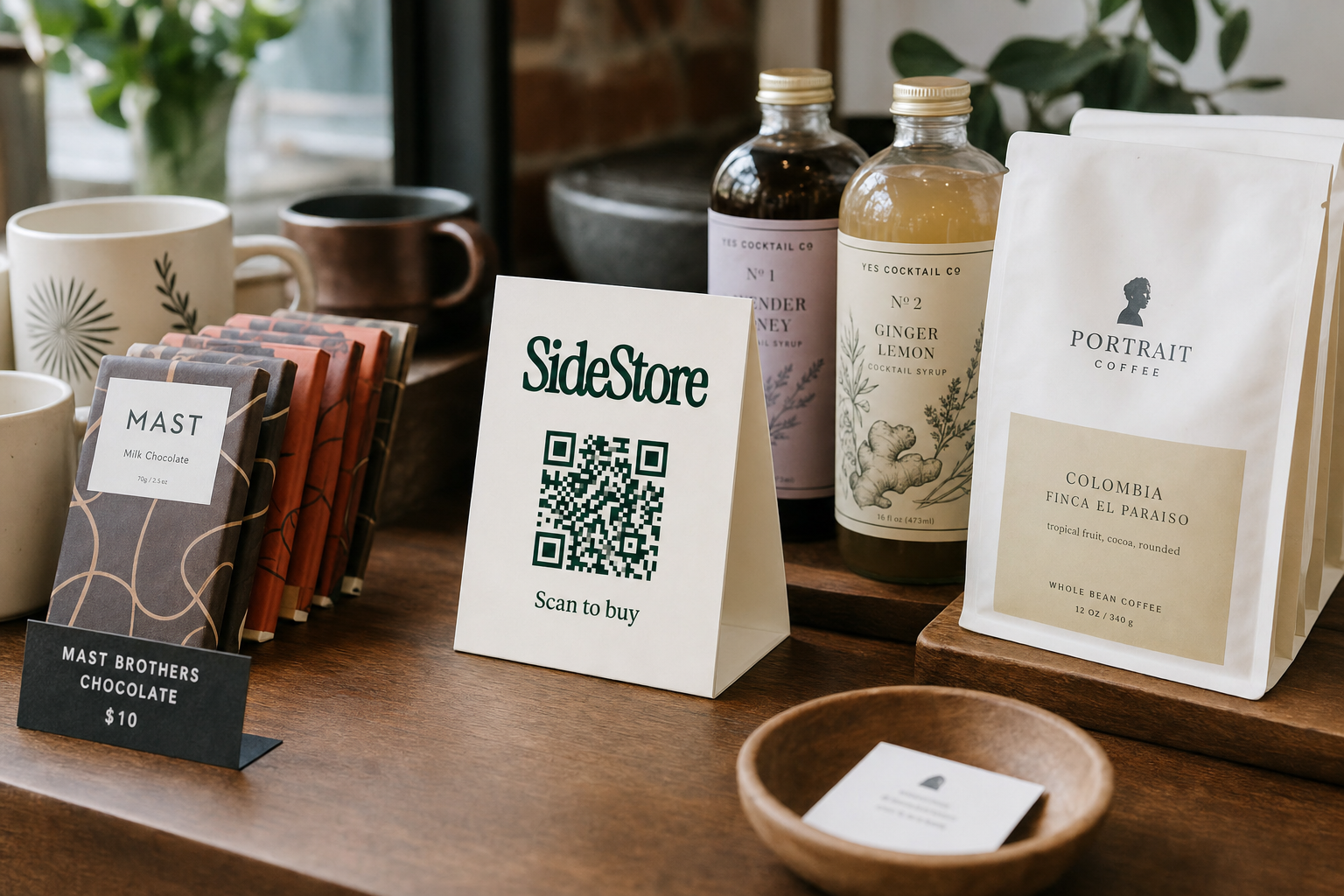
Starting consignment retail in your cafe requires no purchasing, no complicated setup, and no new payment hardware. The steps below take you from empty shelf to active revenue.
1. Identify your idle space. Walk your floor and counter area with fresh eyes. A windowsill, a corner shelf, a section of counter near the queue, space next to the till. These are placement candidates. You need enough room to display a product clearly, not an entire retail floor.
2. Find a local maker whose products suit your customers. Think about what your regulars already buy or comment on. Ceramics, candles, locally roasted whole beans, skincare, stationery, printed art. A product that fits your cafe's aesthetic and your customer's lifestyle converts better than a generic selection. For makers looking for placement opportunities, resources like how to sell handmade products in physical stores on consignment, how local makers can sell products without opening a retail store, and alternatives to weekend markets for artists and small brands describe exactly what they are looking for in a host.
3. Set up the placement through SideStore. The maker creates the placement in SideStore and configures the Retail Widget for your space. The Widget handles checkout via a printable QR code card (one function of the Widget, not the whole product), live stock tracking, and automatic split payouts. You do not need a separate till integration or POS modification.
4. Display the products and the QR card. Position the products where customers naturally pause: at the counter during the queue, near the condiment station, on a shelf at eye level. The QR card sits with the product. Customers scan, pay, and the sale is recorded and settled automatically.
5. Review performance and adjust. The Retail Widget shows you which products are selling and at what rate. If something is not moving, work with the maker to adjust placement or swap the product. This is a low-stakes iteration, because you have no inventory at risk.
Other Revenue Streams Worth Considering
Beyond consignment retail, several other revenue streams are worth a cafe's attention, though they vary significantly in the capital and effort they require.
Takeaway meal kits or pantry bundles. Packaging signature items, such as your house blend with a brewing guide, as a purchasable bundle adds a higher-margin transaction without table service. Requires product development but no additional space.
Private hire and events. If your space has a quiet period, morning or evening hire for meetings, workshops, or small celebrations generates revenue from hours that would otherwise be empty. Requires coordination but minimal capital.
Barista classes or tasting sessions. Knowledge-based offerings convert well in cafes with a clear coffee identity. The margin can be strong because the main input is staff time, not goods.
Subscription or loyalty schemes. A prepaid coffee subscription (a set number of drinks per month at a slight discount) improves cash flow predictability and locks in return visits. It requires minimal infrastructure.
Hosting products for other venue types. The consignment model scales beyond cafes. Hotels, bed and breakfasts, and high-traffic retailers operate on the same logic: earn from space you already have. See how hotels can turn lobby and reception space into retail revenue, how bed and breakfasts can make money from a small retail corner, and how high-traffic retailers can monetise idle shelf space for how adjacent venue types apply the same principle.
Frequently Asked Questions
The following questions reflect what cafe owners and managers most commonly ask when looking to improve profit from a coffee shop. Each answer is kept concise and direct.
How much profit does a coffee shop make per cup? The gross margin on an espresso-based drink is typically high relative to the direct cost of ingredients, but net profit per cup is much thinner once rent, wages, and overheads are allocated across every transaction. Industry estimates vary widely depending on format and location, so the honest answer is: it depends more on your occupancy cost than your bean cost.
Can a coffee shop make money from selling products? Yes, and it is one of the most accessible revenue levers available. Products sold at the counter, whether coffee retail or maker goods on consignment, add revenue without requiring additional table turns or staff hours. Consignment is particularly attractive because you earn a split payout on each sale with no stock purchased. See selling to consignment for how the model works from the maker's side.
What products sell best in a coffee shop retail display? Products that align with the cafe's identity and the customer's lifestyle perform best. Whole bean coffee, ceramics, candles, locally made food products, and small-format art or stationery are common strong performers. The key factor is curation: a small, well-chosen selection consistently outperforms a large, generic one.
Do I need a separate payment system to sell retail products in my cafe? Not with SideStore. The Retail Widget handles checkout via a scan-to-pay QR code card that customers use on their own phones. There is no separate till integration required and no new hardware to install. If you are exploring how to start selling without infrastructure, how to start selling without inventory covers the broader principle.
The Straightforward Path to a More Profitable Coffee Shop
The simplest path to a more profitable coffee shop is to address the three levers in order: tighten costs, raise average transaction value, and then add a revenue stream that requires no capital. That sequence works because each step builds on the last without compounding your risk.
Cost reduction is unglamorous but immediate. Transaction value improvements are incremental and cumulative. And consignment retail, specifically hosting local makers through a platform like SideStore, is the only lever that generates income from space you are already paying for, with no purchasing decision, no unsold stock, and no new operational complexity.
You do not need to redesign your cafe, hire more staff, or buy a single unit of inventory to make this work. You need a shelf, a local maker, and the Retail Widget to connect them. Profit from a coffee shop improves when every square metre in the space is working, not just the tables.
Start with the shelf space you already have. Read how cafes can make money from unused shelf space, then set up your first consignment placement through SideStore.