A coffee shop profit margin is the percentage of revenue left after subtracting costs, and for most independent cafes, that number is smaller than owners expect.
The average coffee shop gross margin runs between 25% and 40% of revenue, depending on drink mix and pricing. Net margin, what survives after labour, rent, and overheads, typically lands between 2.5% and 6.5% for independent operators. High-volume drive-through kiosks can push net margins toward 15, 20%, while franchise locations often sit in the 6, 9% range after royalties.
Those numbers explain why so many cafes that feel busy still struggle to be profitable. Understanding where the gap lives, between gross and net, is the first step to closing it. You can read a full breakdown of coffee shop profit margins or explore how much profit a coffee shop makes across different operator types.
The sections below cover benchmarks by shop type, the four cost drivers that compress margins, how to calculate your break-even point, and which levers actually move the needle.
Gross Margin vs Net Margin: What the Numbers Actually Mean
Gross margin measures revenue minus the direct cost of goods sold (COGS); net margin measures what remains after every operating expense. For a cafe, the gap between those two figures is where most of the financial story lives.
Coffee has naturally high gross margins. A flat white costs perhaps 30, 50p in raw materials but sells for £3.50, £5.00, which is why specialty drinks can sit at 65, 75% gross margin on the drink itself. But "gross margin on a drink" is not the same as "gross margin on the business." Once you account for all product costs, milk, syrups, packaging, waste, whole-business gross margin typically lands in the 25, 40% range.
Then the real costs arrive. Labour commonly absorbs 35, 40% of revenue in a staffed cafe. Rent and occupancy typically account for another 10, 15%. Utilities, insurance, marketing, card fees, and consumables together claim another 5, 10%. Run the arithmetic:
- Revenue: 100%
- COGS: 25, 35%
- Labour: 35, 40%
- Rent and occupancy: 10, 15%
- Other overheads: 5, 10%
- Net margin remaining: roughly 2.5, 6.5%
That is a thin band. A cafe turning over £30,000 per month might clear £750, £1,950 in net profit. A single bad month, an equipment repair, a slow week, a rent increase, can erase it.
The useful thing about this arithmetic is that it shows you where to look. Labour and rent are fixed or semi-fixed in the short run, so COGS and ancillary revenue streams are where most operators find margin. You can explore more on profit from a coffee shop to see how different operators structure these numbers.
Profit Margin Benchmarks by Coffee Shop Type
Not all cafes face the same margin pressure. Shop format, location, and revenue mix each shift the numbers meaningfully, and knowing where your format sits sets realistic expectations before you try to improve.
| Shop Type | Gross Margin (approx.) | Net Margin (approx.) | Key Margin Driver |
|---|---|---|---|
| Drive-through kiosk | 60, 70% | 15, 20% | Low rent, high throughput, lean staffing |
| Independent sit-down cafe | 25, 40% | 2.5, 6.5% | Labour intensity, rent, variable footfall |
| Specialty / third-wave cafe | 30, 45% | 3, 8% | Premium pricing offsets higher bean costs |
| Franchise chain location | 35, 50% | 6, 9% | Buying power, royalties compress net margin |
| Cafe with retail shelf sales (consignment) | 30, 48% | 5, 12% | Near-zero COGS on hosted retail products |
The drive-through kiosk figure stands out because the format eliminates the two biggest cost lines: seating space (less rent) and table-service labour. Specialty cafes price higher but source more expensively, so gross margins are not dramatically better than an independent, the gain shows up in average transaction value instead.
The consignment retail row is the one that often surprises operators. When a cafe hosts maker products on consignment, it earns a percentage of each sale without buying stock. That revenue carries almost no COGS for the host, which is why it can lift both gross and net margins simultaneously. The mechanics are covered in detail in how cafes earn from unused shelf space and in the coffee shop retail products overview.
One structural point worth noting: franchise operators benefit from centralised buying power, which compresses COGS, but royalties (typically 5, 10% of revenue) offset much of that gain, leaving net margins that rarely outperform a well-run independent.
The Four Cost Drivers That Compress Coffee Shop Margins
Four cost lines do most of the damage to coffee shop margins: COGS, labour, rent, and the cluster of smaller overheads that operators often underestimate. Managing all four, rather than fixating on just one, is what separates sustainable cafes from ones that are permanently cash-thin.
1. Cost of Goods Sold (COGS): target 25, 35% of revenue
For a cafe running £10,000 per month in revenue, COGS should ideally stay below £3,500. This includes coffee beans, milk, syrups, food, packaging, and waste. Waste alone can account for 3, 5% of revenue if portion control and ordering are loose. Tracking COGS weekly rather than monthly catches drift early.
2. Labour: target 35, 40% of revenue
On £10,000 monthly revenue, that is £3,500, £4,000. Labour is the hardest cost to cut without affecting customer experience, under-staffing shows immediately in service quality and reviews. The better lever is revenue per labour hour: scheduling peak coverage tightly and filling quieter hours with prep and admin rather than excess floor staff.
3. Rent and occupancy: target 10, 15% of revenue
At 10, 15%, a cafe earning £10,000 per month should be paying £1,000, £1,500 in rent. If rent exceeds 15%, the revenue base needs to grow to compensate, reducing the lease is rarely an option mid-term. This is one reason location research before signing a lease matters more than almost any other decision.
4. Other overheads: 5, 10%
Utilities, card processing fees (typically 1.5, 2.5% of card revenue), insurance, marketing, and software subscriptions. These feel small individually but aggregate quickly. Card fee creep in particular is worth auditing annually.
The prime cost ratio
Prime cost, labour plus COGS combined, is the single most useful indicator of margin health. A prime cost ratio below 65% of revenue leaves room for rent, overheads, and profit. Above 65%, the math rarely works at typical rent levels.
On £10,000 revenue: if COGS is £3,000 and labour is £3,800, prime cost is £6,800, 68%. That leaves £3,200 for rent, utilities, insurance, and profit. At £1,500 rent and £1,200 overheads, you net £500. A lean month erases it. You can explore the range of realistic outcomes in the average profit for a coffee shop breakdown, and non-profit coffee shop models cover the edge cases where a different structure applies entirely.
How to Calculate Your Coffee Shop Break-Even Point
Your break-even point is the revenue level at which you cover all costs and make zero profit, and knowing that number precisely tells you whether a slow week is merely painful or actually dangerous.
The formula is straightforward:
Break-even revenue = Fixed costs ÷ Gross margin percentage
Here is a worked example. Suppose your monthly fixed costs are:
- Rent: £2,000
- Labour (base staffing): £4,000
- Utilities and insurance: £800
- Software, card fees, and other: £400
- Total fixed costs: £7,200
Your gross margin (after COGS) is 35%.
Break-even revenue = £7,200 ÷ 0.35 = £20,571 per month
Divided across 26 trading days, that is roughly £792 per day. If your average transaction is £4.50, you need approximately 176 transactions per day before you make a single pound of profit.
That is your break-even transaction count. Anything above it contributes to net margin; anything below it adds to a loss.
Two important distinctions follow from this. First, break-even is not the same as profitability. Break-even covers costs; profitability requires revenue meaningfully above that threshold to justify the owner's time and capital risk. Second, break-even assumes a fixed cost structure. If you add a member of staff or take a larger space, recalculate immediately, the threshold shifts.
Operators who know their daily break-even can make staffing and opening-hour decisions in real time rather than discovering a shortfall at month end. For a fuller view of how these revenue streams interact, the coffee retail shop revenue streams article covers the components in detail.
Five Ways Coffee Shops Improve Their Profit Margin
Improving the average coffee shop profit margin comes down to five levers, and the most durable gains usually come from combining two or three rather than pushing any single one to its limit.
1. Raise average transaction value
Upselling a pastry with every drink order, or introducing a loyalty structure that rewards higher-value orders, lifts revenue without adding customers or hours. Moving average transaction value from £4.50 to £5.20 on 150 daily transactions adds roughly £1,050 per month in gross revenue, nearly £370 in net margin at a 35% gross margin rate.
2. Reduce COGS through tighter ordering and waste control
Cutting waste from 5% of revenue to 2% on a £20,000-per-month turnover saves £600 monthly. That goes straight to net margin. Weekly stock counts and par-level ordering are the mechanism; they are unglamorous but consistently effective.
3. Improve labour scheduling
Matching staffing to footfall data, pulling back in slow mid-morning windows, covering the 8, 9am rush tightly, can reduce labour cost by 3, 5% of revenue without reducing perceived service quality. On £20,000 monthly turnover, 3% is £600.
4. Introduce a recurring revenue element
Coffee subscriptions, pre-sold event packages, and catering arrangements convert variable footfall into predictable income. Predictable income makes prime cost planning more precise and reduces the risk of a bad-weather week wiping out a month's margin.
5. Add consignment retail to your shelf space
This is the lever that changes the structural logic of your margin, not just the scale of it. When you host maker products on consignment, candles, ceramics, prints, small-batch food, you earn a percentage split on every sale without purchasing stock. Your COGS on that revenue line is effectively zero.
The SideStore Retail Widget is the interface that manages this end to end: checkout (including a scan-to-pay QR that customers use directly from your shelf display), live stock tracking, and automatic split payouts to the maker and to you. There is no till integration to manage and no invoicing at month end.
If a single shelf placement generates £150 per month in maker product sales and your split is 25%, that is £37.50 arriving with no COGS. Across four placements, it is £150 per month in near-pure margin, the equivalent of serving around 42 additional flat whites. You can see how earn from unused shelf space and selling on consignment explain the full mechanics.
How Retail Shelf Sales Change the Margin Equation
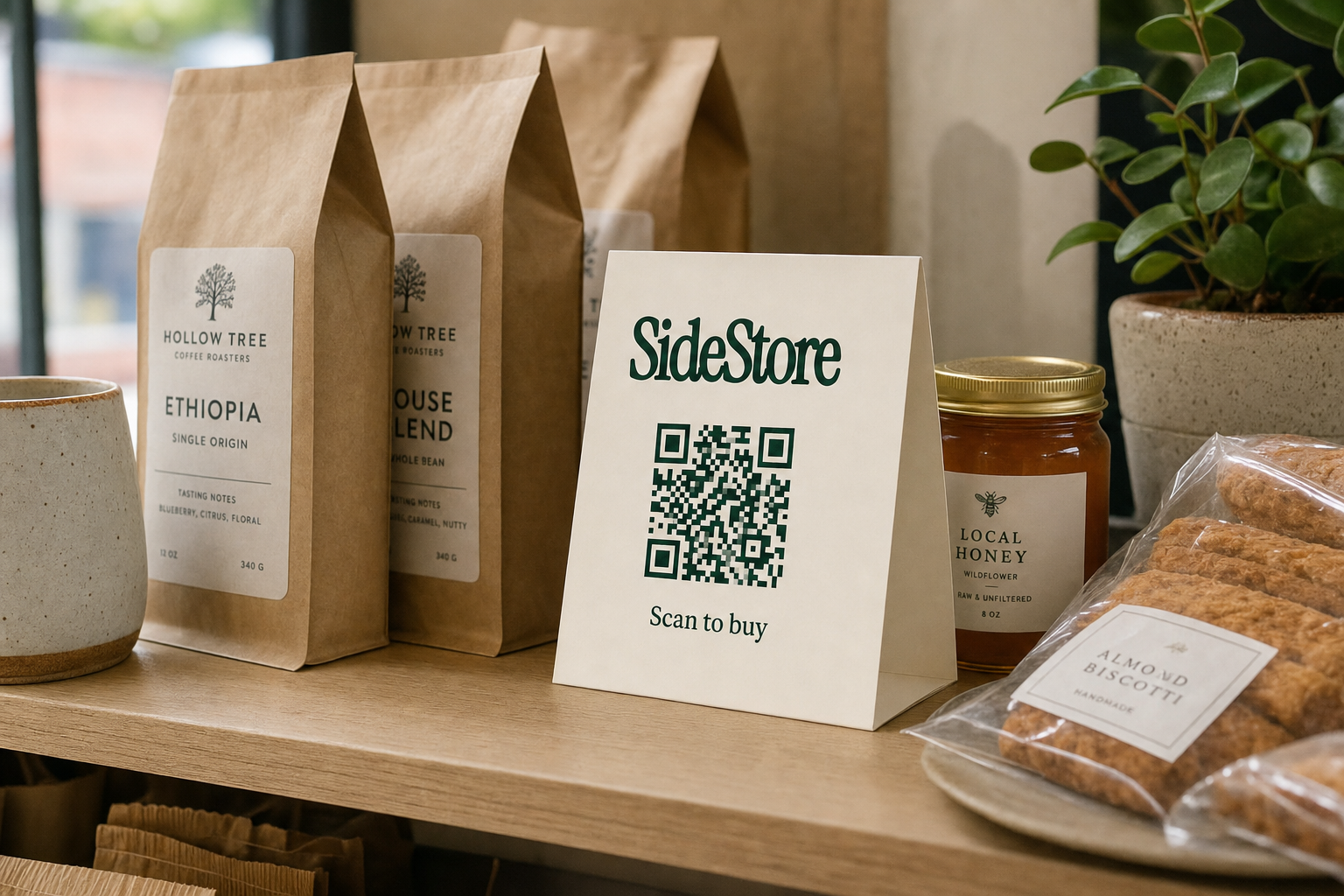
Consignment retail does not just add revenue, it changes which costs are attached to that revenue. That structural difference is why it improves margins rather than simply expanding turnover.
When a cafe buys wholesale stock to resell, it carries COGS on that inventory, takes the risk of unsold units, and ties up cash in stock. When a cafe hosts products on consignment, the maker retains ownership of the stock until the moment of sale. The cafe's COGS on that revenue line is near-zero, primarily the square footage it was already paying for.
The Retail Widget handles the operational layer: placement, checkout via scan-to-pay QR, live stock tracking, and automatic split settlement between maker and host. You are not running a shop-within-a-shop; you are activating space that already exists.
The margin arithmetic is straightforward. Suppose a consignment shelf generates £500 per month in product sales at a 30% host split. That is £150 in revenue against costs of perhaps £0, £10 in incidental effort. The same £150 earned from coffee sales would require roughly £97 in COGS alone at a 35% gross margin.
This is why the benchmark table above shows cafes with retail shelf sales consistently outperforming on both gross and net margin. The revenue mix matters, not just the volume. The same principle applies across other hospitality formats, how hotels turn lobby space into retail revenue shows the pattern at a different scale. The full mechanics of selling through consignment explain the host and maker side of the arrangement in detail.
Frequently Asked Questions About Coffee Shop Profit Margins
These are the questions operators most commonly ask when they start looking seriously at their numbers. The answers use verified ranges rather than false precision, coffee shop economics vary enough that a single figure is rarely honest.
Is a coffee shop a profitable business?
Yes, but with significant variance. A well-run independent cafe with controlled prime costs and a strong location can sustain 5, 8% net margin. Many cafes, however, operate at 2, 3% or break even. Profitability depends more on cost discipline than on revenue volume. See how much profit a coffee shop makes for a fuller breakdown.
What is a good profit margin for a coffee shop?
A net margin of 6, 10% is generally considered healthy for an independent cafe. Achieving it typically requires prime cost (labour plus COGS) below 65% of revenue and rent below 12%. Drive-through kiosks can exceed this; full-service sit-down cafes rarely do without additional revenue streams.
How much revenue does the average coffee shop make?
Revenue varies enormously by format and location. A small independent cafe in a mid-sized UK city might turn over £15,000, £30,000 per month; a high-footfall urban location could exceed £60,000. These figures are illustrative rather than prescriptive, your own break-even calculation, not an industry average, is the number that actually matters.
Can a coffee shop survive on coffee alone?
Technically yes, but the margin pressure is significant. Coffee-only cafes leave food, retail, and ancillary revenue on the table, all of which carry higher or comparable margins and reduce the dependence on volume. Most operators who achieve sustainable margins do so with a mixed revenue model.
What the Numbers Tell You, and What to Do Next
The most important numbers in coffee shop economics are three: your gross margin, your prime cost ratio, and your daily break-even transaction count. If you know those three, you know where you stand and where to push.
Start today by calculating your prime cost ratio: add last month's COGS and labour, divide by total revenue. If the result is above 65%, that is where to focus first.
If your prime cost is already controlled, the next lever is adding a revenue stream with near-zero COGS. Consignment retail is the most practical option for most cafes, how cafes can earn from unused shelf space shows the mechanics in full. If you are a maker looking at the other side of this arrangement, alternatives to weekend markets for makers covers how consignment placements compare to other distribution options.