How Much Profit Does a Coffee Shop Make
Coffee shops typically net 3, 9% profit. See benchmarks by shop type, the four cost drivers that matter most, and concrete ways to raise your margin.
Coffee shop profit is the revenue left over after paying for goods, labor, rent, and every other operating cost. Most coffee shops net between 3% and 9% of revenue, meaning a shop turning over $300,000 a year clears roughly $9,000 to $27,000 in net profit. Specialty independents with strong retail and food programs can push past that range; high-rent urban cafes often fall below it.
If you want to understand what drives that number up or down, you need to separate gross profit from net profit, know which cost categories eat the most margin, and have a realistic picture of what year one actually looks like versus year three. The sections below cover all of it, including where coffee shop profit margins tend to cluster and what the data on profit from a coffee shop actually shows.
Gross Profit vs Net Profit: What the Numbers Actually Mean
Gross profit is what remains after subtracting the direct cost of the products you sell (cost of goods sold, or COGS). Net profit is what remains after subtracting everything else: labor, rent, utilities, insurance, and any other operating expense.
Here is a concrete illustration. Say your café generates $400,000 in annual revenue. Your COGS (coffee beans, milk, food ingredients, packaging) runs 30%, so $120,000. That leaves a gross profit of $280,000, or a 70% gross margin. Strong. But then you subtract:
- Labor: $140,000 (35% of revenue)
- Rent: $48,000 (12%)
- Utilities, insurance, software, maintenance: $40,000 (10%)
Total operating costs: $228,000. Net profit: $52,000, or 13%. That is an above-average outcome. In many real-world scenarios, rent is higher, labor costs creep up, and net margin compresses to 5% or less.
The gap between a 70% gross margin and a 5% net margin is where most café owners get caught off guard. Gross margin tells you how well you price and source. Net margin tells you how well you run the business. For a deeper look at where each percentage point goes, see the coffee shop profit margin breakdown.
Profit Benchmarks by Coffee Shop Type
Not every café operates the same way, and the format you choose shapes your margin ceiling from day one. A pavement kiosk carries almost no rent burden; a full sit-down café carries significant overhead. The table below shows typical benchmarks by shop type. Treat these as honest ranges, not guarantees.
| Shop Type | Typical Annual Revenue | Estimated Net Margin | Estimated Net Profit Range |
|---|---|---|---|
| Coffee kiosk / cart | $75,000, $150,000 | 10, 18% | $7,500, $27,000 |
| Drive-through only | $200,000, $400,000 | 8, 15% | $16,000, $60,000 |
| Small sit-down café (under 1,000 sq ft) | $150,000, $350,000 | 3, 8% | $4,500, $28,000 |
| Mid-size independent café | $300,000, $600,000 | 4, 9% | $12,000, $54,000 |
| Specialty / destination café | $400,000, $900,000 | 5, 12% | $20,000, $108,000 |
| Non-profit or community café | Varies widely | Break-even to 3% | $0, $15,000 |
A few observations worth making: kiosks and drive-throughs outperform sit-down formats on net margin because they skip the rent and staffing costs that floor space demands. Specialty cafes earn wider margins by commanding higher ticket prices and by layering in retail revenue, events, and subscriptions. For context on how non-profit coffee shop models approach financial sustainability differently, that lens is worth understanding separately.
The clearest takeaway from this table: format determines your cost floor before you sell a single cup.
The Four Costs That Make or Break a Coffee Shop's Margin
Four cost categories account for the vast majority of a café's expenses. Get any one of them wrong and the margin gap closes fast. Here they are, in order of typical impact.
Cost of Goods Sold (COGS). This covers ingredients, packaging, and any retail products you stock yourself. For a well-run café, COGS should sit between 25% and 35% of revenue. Food-heavy menus push COGS higher; a drinks-only operation can hold it lower. The trap is menu creep: every new item you add that you cannot price correctly erodes gross margin.
Labor. Labor is usually the single largest line item, typically running 35% to 40% of revenue when you include wages, payroll taxes, and benefits. Scheduling efficiency matters enormously here. Being overstaffed during slow periods by even one person per shift compounds quickly across a year.
Rent and occupancy. Industry benchmarks suggest keeping rent below 10, 15% of revenue. High-foot-traffic locations cost more but often justify the premium through volume. A lease at 20% of revenue is a structural problem that almost no operational improvement can fully fix. Location choice is a long-term margin decision.
Operating overhead. Utilities, insurance, POS and software subscriptions, repairs, and supplies typically account for 8, 12% of revenue in aggregate. These costs are individually small but collectively significant, and they tend to grow as the business grows. Reviewing your coffee retail shop operations line by line at least quarterly is worthwhile, because overhead has a way of accumulating unnoticed.
The math is unforgiving: COGS (30%) + Labor (38%) + Rent (12%) + Overhead (10%) = 90% of revenue. That leaves a 10% net margin in an optimistic scenario. Slip on any one driver and you are at 5% or below.
What Raises (and Lowers) Coffee Shop Profit
Several factors move coffee shop profit in both directions. Knowing both sides is more useful than a list of upsides alone.
What raises profit:
- Higher average ticket. Selling food, specialty drinks, or retail products alongside espresso raises revenue per customer without proportionally increasing fixed costs.
- Consistent throughput during peak hours. A well-run morning rush is worth more than extended hours on a quiet afternoon.
- Retail with no inventory risk. Consignment retail is a low-friction margin lever that many café operators overlook. Under a consignment arrangement, a maker supplies the inventory, the café earns a revenue split at point of sale, and the café takes on zero upfront stock cost. Platforms like SideStore handle the full placement through the Retail Widget, which manages checkout (including scan-to-pay), live stock tracking, and automatic split payouts. The café earns from shelf space it already has. For specifics on how this works in practice, see how cafes can make money from unused shelf space and monetize idle shelf space.
- Loyalty and repeat visit rate. Lower customer acquisition cost than any paid channel.
What lowers profit:
- Rent creep. Taking on a larger or better-located space before revenue supports it.
- Menu complexity. More SKUs mean more waste, more training time, and more prep cost.
- Inconsistent staffing. High turnover raises hiring and training costs steadily.
- Supplier complacency. Not renegotiating bean contracts or food supplier terms annually is a quiet margin drain.
- Underpricing. Especially on food items and specialty drinks where customers are often less price-sensitive than operators assume.
How Revenue Mix Affects Profit: A Breakdown
The revenue streams in your café do not all contribute equally to net profit. Drinks carry high gross margins; food is more variable; stocking retail inventory yourself comes with COGS and waste risk. The table below frames each stream by its typical cost and contribution profile.
| Revenue Stream | Typical COGS % | Typical Net Contribution | Complexity to Operate |
|---|---|---|---|
| Espresso-based drinks | 20, 30% | High | Low |
| Batch brew / filter coffee | 10, 20% | High | Low |
| Food (prepared in-house) | 30, 45% | Medium | High |
| Pre-packaged food (bought wholesale) | 35, 50% | Low, Medium | Low |
| Retail (self-purchased inventory) | 40, 60% | Low, Medium | Medium |
| Retail (consignment, no inventory buy) | 0% upfront | Medium (split payout) | Very Low |
| Events / private hire | Variable | High (when priced correctly) | Medium |
The consignment retail row stands out for one reason: the COGS to the café is zero at point of placement. You earn a split when something sells. No purchase order, no write-down risk on slow movers. For cafes that are curious about adding local products without buying inventory, or who want to understand more about what selling on consignment looks like in practice, those are useful starting points.
The broader point: optimizing your revenue mix toward high-margin, low-complexity streams is more reliable than trying to cut costs that are already tight.
Six Concrete Ways to Improve Your Coffee Shop's Profit
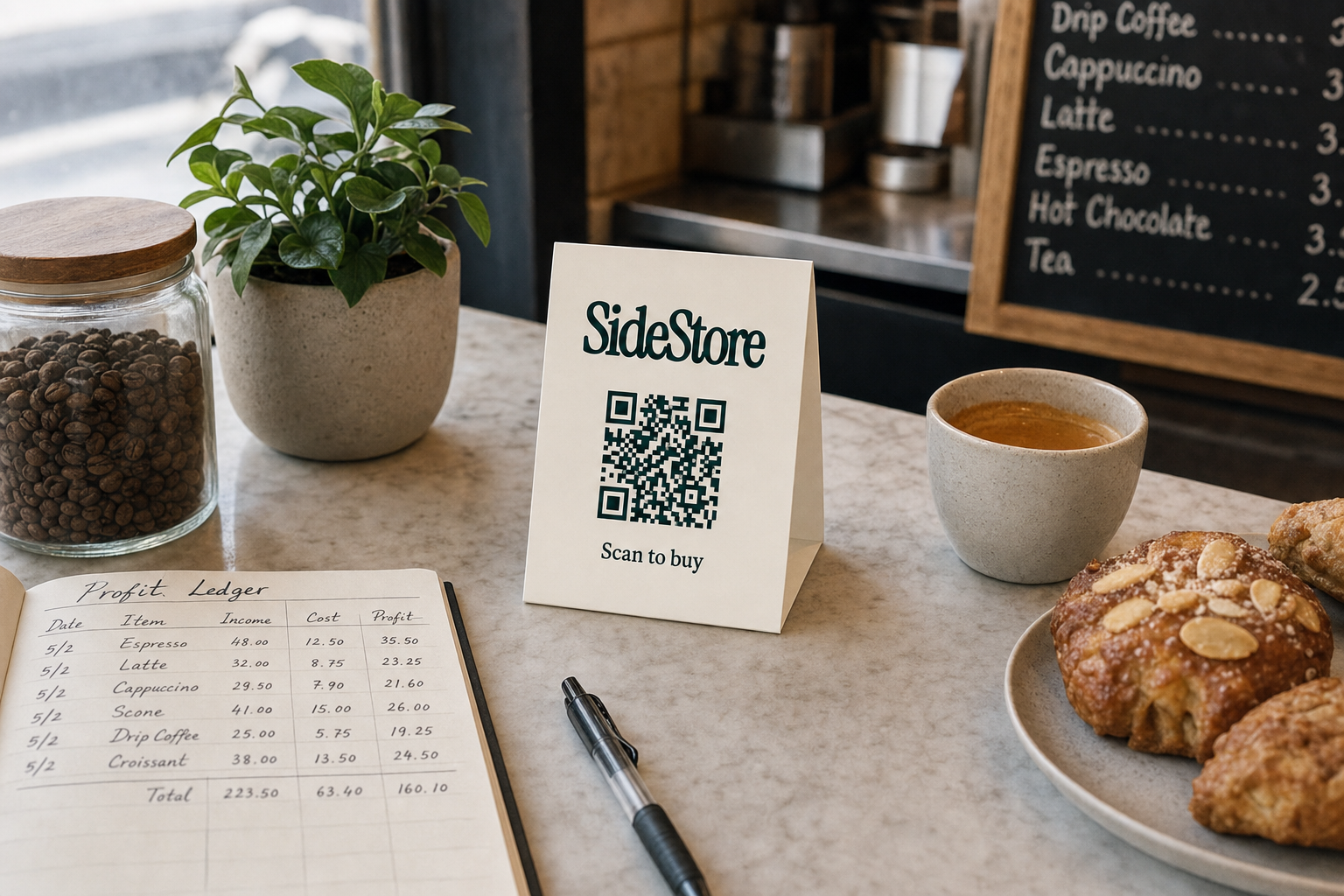
Improving profit comes down to moving specific levers, not making general improvements across the board. Here are six that have the most reliable impact.
1. Raise average ticket through intentional upselling. Train staff to suggest add-ons at the point of order: an oat milk upgrade, a pastry pairing, a bag of beans to take home. Even a $1.50 average ticket increase across 100 daily transactions adds $54,750 in annual revenue at near-zero additional cost.
2. Renegotiate your bean contract annually. Coffee is a commodity with significant price swings. Locking in longer-term supply agreements with your roaster, or consolidating volume, often yields 5, 10% cost savings on your top ingredient.
3. Tighten your schedule to actual footfall. Pull your transaction data by half-hour increments. Most cafes have one or two slow periods where they are overstaffed by at least one person. Correcting a single weekly scheduling inefficiency can recover several thousand dollars annually.
4. Add consignment retail using the Retail Widget. Place local maker products on your counter or a dedicated shelf on consignment. With SideStore's Retail Widget, the maker supplies inventory, the system handles checkout via scan-to-pay QR, tracks live stock, and automatically splits the payout between you and the maker. No inventory to buy, no stock risk, no manual reconciliation. The QR checkout is one function of the Retail Widget; the full system manages the placement end to end. See how high-traffic retailers can monetize idle shelf space and how the SideStore QR card works for setup detail.
5. Introduce a subscription or loyalty program. Predictable monthly revenue from a coffee subscription smooths cash flow and raises lifetime value per customer.
6. Audit and cut low-margin menu items quarterly. A menu item that sells slowly and has high COGS is a double cost: ingredients that spoil and staff time to prepare. Removing two or three of these per quarter is typically invisible to customers and immediately visible on gross margin.
Year One vs Year Three: What Realistic Profitability Looks Like Over Time
Most coffee shops do not make money in year one, and that is not a failure, it is the normal shape of the business. Here is what realistic trajectories look like.
Year One. Expect to operate at break-even or at a net loss. Setup costs, initial slow trade, staff training, and menu iteration all compress margin. Many independent cafes report covering operating costs but not fully recouping startup investment in year one. Illustratively, a café with $280,000 in first-year revenue might net $0, $8,000 after all costs, or run slightly negative.
Year Two. Volume grows as the customer base regularises. You have eliminated slow menu items, refined your staffing schedule, and your rent is now a smaller percentage of rising revenue. Net margins typically climb into the 3, 6% range. This is also the phase where layering in additional revenue streams, such as retail on consignment, starts to move the needle without adding operational load.
Year Three and Beyond. Operators who have controlled rent, built a loyal customer base, and diversified revenue realistically achieve 6, 12% net margins. The compounding effect of repeat customers and optimized operations becomes significant. Managing your product mix carefully, including managing inventory for retail if you stock physical goods, and knowing how to get rid of slow-moving inventory when lines underperform, keeps margins from backsliding.
Frequently Asked Questions
These questions reflect what café owners and prospective operators search for most often around coffee shop profitability.
Is owning a coffee shop profitable? Yes, but the margins are thin and the timeline is longer than many owners expect. Most independent cafes reach consistent profitability in year two or three, with net margins between 3% and 9%. Format, location, and revenue mix are the biggest determinants of whether you end up in the top or bottom of that range.
How much does a coffee shop owner make per year? This depends heavily on whether the owner takes a salary as an operator or draws from net profit. In a café netting 5% on $350,000 in revenue, that is $17,500 in net profit before the owner's draw. Many owner-operators pay themselves a salary from operating costs, which reduces reported net profit but reflects their actual compensation. See profit from a coffee shop for a fuller picture.
What is the average revenue for a small coffee shop? A small sit-down café typically generates between $150,000 and $350,000 in annual revenue, depending on location, hours, and menu. A well-placed urban café with strong morning trade can exceed that; a rural or suburban independent may fall below it.
How can a coffee shop increase profit without increasing revenue? The most effective levers are cost-side: tighten labor scheduling, renegotiate supplier contracts, cut low-margin menu items, and reduce waste. Adding consignment retail is one of the few ways to increase net income without increasing revenue from existing products, because the COGS to the café is zero. For a full coffee shop profit margin breakdown, the levers become clearer in context.
The Bottom Line on Coffee Shop Profit
Coffee shops typically net 3, 9% of revenue. That margin is achievable, but it requires controlling the four main cost drivers, COGS, labor, rent, and overhead, and actively managing your revenue mix. The two levers that move the needle most reliably are labor scheduling and high-margin, low-complexity revenue streams. For many cafes, consignment retail is the fastest path to the second lever: zero inventory cost, automatic settlement, and income from shelf space you already have. Start by reading how cafes can make money from unused shelf space, then explore how consignment works for merchants to see the mechanics in full.