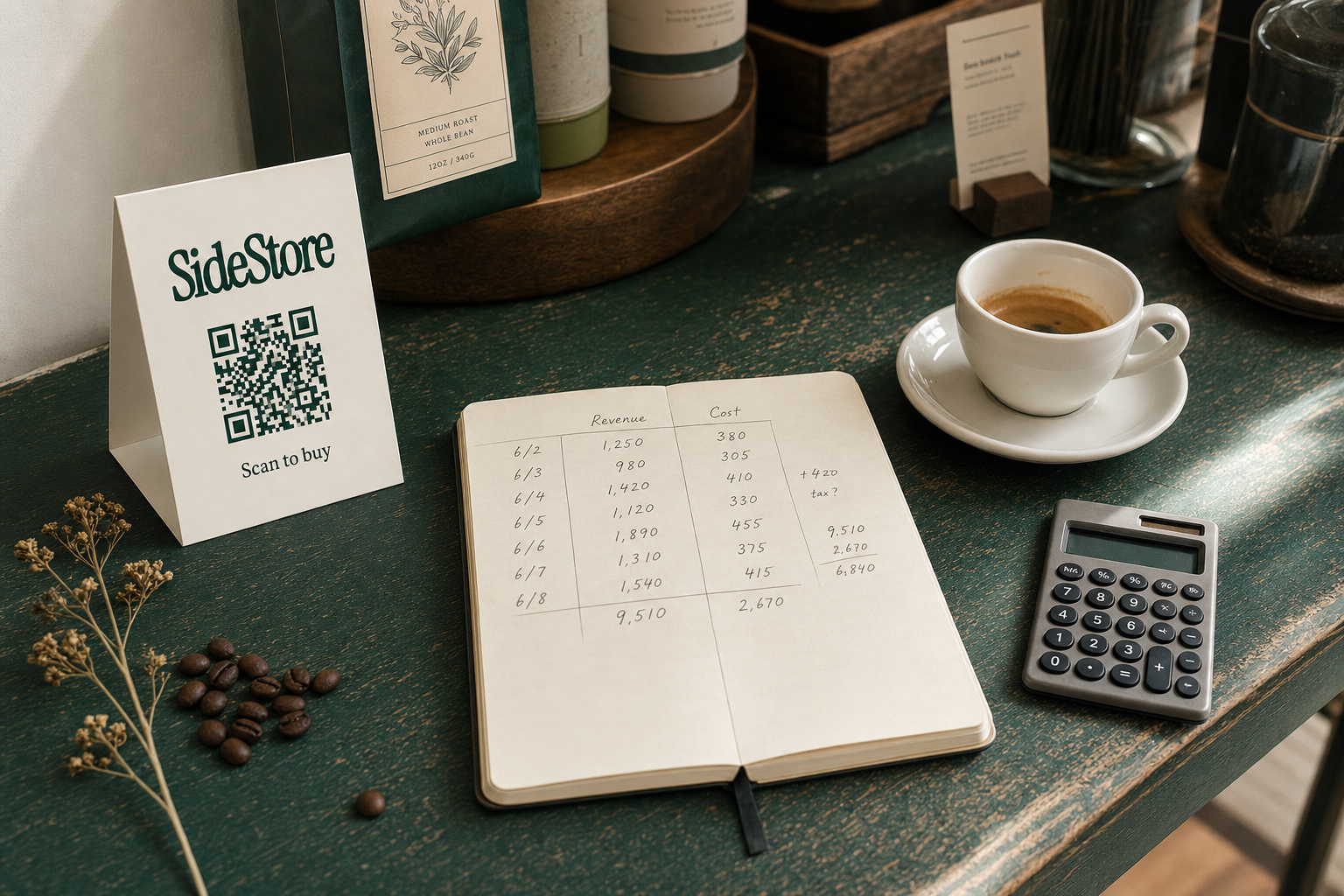
A coffee shop profit margin calculator does one job: it divides your net profit by your total revenue and multiplies by 100. Run it monthly and you have one of the most useful numbers in your business.
The formula is straightforward:
Net Profit Margin (%) = (Revenue − Total Costs) ÷ Revenue × 100
Industry benchmarks place most independent coffee shops between 2.5% and 6.5% net margin. Specialty cafés with strong retail sales and tight cost control can push toward the higher end. Shops running on slim volumes or in high-rent locations often sit at the lower end or below it.
The sections below cover how much profit a coffee shop makes in practice, how to distinguish gross from net margin (they tell very different stories), the five cost categories that compress your number most, and one overlooked lever, consignment retail on idle shelf space, that adds revenue without adding inventory risk. For a broader look at coffee shop profit margins across shop types, that companion article is worth reading alongside this one.
The Coffee Shop Profit Margin Formula
Net margin is what you keep. The formula is Revenue minus all costs, divided by revenue, multiplied by 100. Most operators know this in theory but apply it imprecisely because they conflate three different margin figures. Each one tells a different story, and confusing them is a common source of misplaced optimism.
Gross margin covers only the cost of goods sold (COGS): the coffee beans, milk, syrups, and packaging that go directly into your products. Industry-reported COGS for coffee shops typically runs 28, 35% of revenue, leaving a gross margin of 65, 72%. That number looks healthy. It is also almost meaningless on its own, because it excludes the costs that actually determine whether your business survives.
Operating margin subtracts labour (industry-reported range: 30, 35% of revenue) and rent (15, 20%) from gross profit. Once you account for those two line items, the margin compresses sharply.
Net margin then subtracts equipment leases, insurance, utilities, marketing, and every other expense. This is the number that matters.
Here is a worked monthly example using $18,000 in revenue:
| Line Item | Best Case | Realistic Case |
|---|---|---|
| Revenue | $18,000 | $18,000 |
| COGS (28% / 33%) | $5,040 | $5,940 |
| Labour (30% / 35%) | $5,400 | $6,300 |
| Rent (15% / 18%) | $2,700 | $3,240 |
| Other expenses | $2,000 | $2,400 |
| Net Profit | $2,860 | $120 |
| Net Margin | 15.9% | 0.7% |
The best-case scenario assumes every cost sits at the low end of its range simultaneously. That rarely happens in practice. The realistic case shows how quickly margin evaporates when labour and rent creep toward their upper bounds. Review coffee shop revenue benchmarks to calibrate whether your $18,000 figure is typical, and look at profit from a coffee shop to see how operators at different volumes structure their cost mix.
The key takeaway: gross margin flatters the picture. Net margin is the only figure worth managing.
How to Use the Calculator: A Step-by-Step Walkthrough
To run a coffee shop profit margin calculation, you need five numbers from your last full month of trading: total revenue, COGS, labour costs, rent, and all other operating expenses. Pull them from your POS system and your accounting records, then follow the steps below.
Step 1: Establish your total monthly revenue.
Include every income source: espresso bar sales, drip coffee, food items, retail merchandise, and any catering or wholesale. Do not net anything out yet.
Operator prompt: What did your POS system show as total receipts for the month, including tax-excluded sales?
Step 2: Calculate your COGS.
Add up the cost of all ingredients and packaging consumed during the month. If you run a perpetual inventory system, use the cost-of-goods-sold figure it generates. If not, use: Opening Stock + Purchases − Closing Stock.
Operator prompt: What did you spend on coffee, milk, food inputs, and consumables that were actually used (not just purchased) this month?
Step 3: Calculate your labour cost.
Include wages, payroll taxes, and any contractor payments for staff working in the shop.
Operator prompt: What was your total payroll cost, including your own owner's draw if you pay yourself a fixed wage?
Step 4: List every other operating expense.
Rent, equipment leases, utilities, insurance, software subscriptions, cleaning, and marketing all belong here.
Operator prompt: Pull your bank statement and mark every recurring and one-off expense that is not COGS and not labour.
Step 5: Apply the formula.
Net Profit = Revenue − COGS − Labour − Rent − Other Expenses
Net Margin (%) = Net Profit ÷ Revenue × 100
Build this as a simple Google Sheets table: one column for line items, one for amounts, one for percentage-of-revenue. Google Sheets is free, auto-calculates percentages, and lets you run month-on-month comparisons without manual work. Reviewing your average coffee shop profit against these outputs tells you quickly whether your margin is competitive or whether a specific cost category needs attention.
Coffee Shop Margin Benchmarks: What Is Normal?
Whether your margin is normal depends on your shop type, volume, and location. The 2.5, 6.5% net margin range cited most often is an average across very different business models, not a universal target.
Here is how benchmarks vary by shop type:
- Espresso-bar-only kiosk: Lower overheads and no kitchen; net margins often reported at 6, 10% when volume is adequate.
- Standalone neighbourhood café: The most common format; net margins typically 2, 6%, with rent and labour as the main compressors.
- Full-service café with food menu: Higher revenue potential but significantly higher COGS and labour; margins often 1, 4%.
- Café with strong retail component: Packaged coffee, merchandise, and third-party consignment products add revenue at varied margins; overall net margin can rise by 1, 3 percentage points depending on the retail mix.
The key variables are rent-to-revenue ratio and labour efficiency. A shop paying 20% of revenue in rent needs everything else to run lean. A shop at 12% rent has meaningful headroom. Typical coffee shop profit margins by format are worth reviewing to see where your shop sits relative to comparable operations.
One margin lever most operators overlook is the retail shelf. If your café has unused display space, a windowsill, a counter corner, a small fixture near the till, that space can generate revenue through consignment retail at zero inventory cost to you. The mechanics of this are covered in detail in the article on how to earn from unused café shelf space, but the short version is: a maker places their products in your space, you earn a split of each sale, and you carry no stock risk.
The Five Biggest Margin Drains
Five cost categories account for the vast majority of margin compression in coffee shops. Knowing which one is pulling your number down is more useful than applying generic advice.
| Cost Category | Typical % of Revenue | Why It Compresses Margin | Practical Fix |
|---|---|---|---|
| COGS | 28, 35% (industry-reported) | Every drink priced below its cost contribution destroys margin; inconsistent portioning amplifies this | Audit portion sizes, reprice under-margin items, renegotiate with suppliers on volume |
| Labour | 30, 35% (industry-reported) | The largest single cost for most shops; overstaffing in slow periods is the main culprit | Match scheduling to hourly transaction data; use a POS that shows revenue-per-labour-hour |
| Rent | 15, 20% (industry-reported) | Fixed regardless of trading performance; high-footfall locations carry premium rents that eat margin at low volume | Negotiate rent reviews, add revenue streams that use the same space (events, retail), or relocate at lease end |
| Equipment Lease | 3, 8% (operator-reported range) | Espresso machines, grinders, and refrigeration on finance carry interest and tie up cash flow | Buy outright where capital allows; lease only equipment with a clear revenue ROI |
| Waste and Spoilage | 2, 6% (operator-reported range) | Over-ordering perishables, expired syrups, and unsold food drain margin invisibly | Implement a weekly waste log; use a first-in-first-out stock rotation and reduce food menu complexity |
Rent deserves specific attention. Rent is fixed, but the space it covers does not have to produce revenue only through the espresso bar. Every square metre of shelf, counter, or display space that sits empty is rent you are paying for nothing. Converting idle shelf space into a consignment retail area turns a fixed cost into a partial offset without adding to your own stock obligations. See the section on coffee shop retail for a fuller breakdown of how retail product selection affects the margin calculation.
One Overlooked Margin Lever: Consignment Retail on Idle Shelf Space
Improving margin without cutting costs means adding revenue from assets you already own. For most cafés, that asset is shelf space: a counter corner, a windowsill display, a rack by the door.
Consignment retail works like this: a maker places their products in your café. You display them. When a customer scans the product's QR code and buys, the payment splits automatically between the maker and you. You carry no inventory, purchase no stock, and take no financial risk on unsold units. How consignment selling works covers the model in detail, but the mechanic is simple: no sale, no cost to you.
SideStore's Retail Widget manages the entire placement. It handles checkout via a scan-to-pay QR code on the product or on a single card displayed in the placement area. It tracks live stock levels, attributes each sale to the correct placement location, and runs automatic split payouts to the maker and to you. You do not need a separate POS integration or a new checkout flow.
The margin arithmetic is straightforward. Suppose a maker places ten units of a $30 handmade product in your café and you agree a 25% host split. If four units sell in a month, you receive $30. That is $30 added to your revenue with zero COGS, zero labour, and zero stock risk on your side. On an $18,000 monthly revenue base, $30 is modest. But ten makers, each with a different product, starts to move the number. And the cost to try is zero.
What idle shelf space looks like in practice: the area beside your pastry display that holds nothing, the windowsill with a plant and a spare menu, the rack near the till where impulse purchases happen naturally. These are not dead zones; they are untapped consignment placements. Read the full article on how cafés make money from unused shelf space and the companion piece on running a coffee retail shop for placement and product selection guidance.
Margin Improvement Tactics: Effort vs. Payoff
The best margin fixes are not always the most obvious ones. Some high-effort interventions move the number by less than a low-effort structural change. The table below maps the most common tactics by implementation effort, indicative payoff, and inventory risk.
| Tactic | Effort to Implement | Typical Payoff (Indicative) | Inventory Risk |
|---|---|---|---|
| Reprice under-margin menu items | Low: review and update menu | 0.5, 2% net margin improvement | None |
| Tighten labour scheduling to transaction data | Medium: requires POS analysis and rota discipline | 1, 3% net margin improvement | None |
| Add consignment retail on idle shelf space | Low: place products, display QR, receive split payouts | Variable; illustratively $30, $300/month per placement | None: stock belongs to the maker |
| Introduce a loyalty programme to lift visit frequency | Medium: software setup, staff training, ongoing management | Revenue uplift of 5, 15% (indicative); margin impact depends on cost | None |
| Reduce food menu complexity | Medium: requires menu redesign and customer communication | Reduces waste and COGS by 1, 3% (indicative) | Reduces perishable stock risk |
| Negotiate rent at lease renewal | High: requires market research, legal review, negotiation | 2, 5% net margin improvement if successful | None |
No single tactic transforms a margin. Two or three implemented together, repricing, labour scheduling, and consignment retail, can shift a shop from the low end of the 2.5, 6.5% range toward the midpoint without a single new capital outlay. The tactics with zero inventory risk (consignment retail, repricing, scheduling) are the logical starting point because they require no upfront spend. Venues in other hospitality categories use the same logic: see how hotels monetise lobby space and how bed and breakfasts add retail income through placements.
Frequently Asked Questions
Coffee shop margin questions cluster around a few recurring themes: what number is acceptable, how different margin types relate to each other, what moves quickly, and whether retail products are worth the effort.
What is a good profit margin for a coffee shop?
A net profit margin between 2.5% and 6.5% is the industry-reported range for most independent coffee shops. Kiosks and small-format espresso bars with low rent sometimes report higher. Cafés with full food menus in high-rent locations often sit at the lower end. Anything above 10% is strong by independent café standards and typically requires either high volume or a diversified revenue mix including retail.
What is the difference between gross margin and net margin for a coffee shop?
Gross margin deducts only the cost of goods sold: ingredients and packaging. For coffee shops, gross margin is often reported at 65, 72%. Net margin deducts every cost: labour, rent, equipment leases, utilities, insurance, and all other operating expenses. Net margin for the same shop is typically 2, 7%. Gross margin tells you how efficiently you price your drinks. Net margin tells you whether the business is viable.
How can a small coffee shop increase its profit margin quickly?
The fastest levers are repricing items that are priced below their true cost contribution, tightening labour schedules to match your actual transaction-per-hour data, and reducing food menu complexity to cut waste. Adding consignment retail on idle shelf space is another low-effort option: the coffee shop retail products article covers product selection. It adds revenue with no inventory risk and no upfront cost to you.
Does selling retail products in a coffee shop improve profit margin?
Yes, when managed correctly. Retail products, packaged coffee, branded merchandise, or third-party consignment items, carry different margin profiles than espresso drinks. Consignment retail in particular adds revenue at zero COGS and zero stock risk on the host's side, because the maker owns the inventory. How selling through consignment works explains the split payout structure in full. The net effect is incremental revenue added to the same denominator, which lifts your net margin percentage.
Run the Numbers, Then Put Your Space to Work
Start here: Revenue minus all costs, divided by revenue, times 100. That is your net profit margin, and it is the only figure worth optimising. Pull last month's numbers, build a simple Google Sheets table, and you will have your baseline in under an hour.
Your four-step sequence:
- Calculate your current net margin using the formula above.
- Identify which of the five cost categories is your largest drag.
- Reprice or reschedule to address it. No capital required.
- Activate your idle shelf space through consignment retail and add a revenue line that carries no inventory risk.
Read the full guide on how cafés earn from unused shelf space and, if you work with makers looking for placement, the piece on distribution alternatives for makers is worth passing along.
Build a consignment network without opening a store of your own.