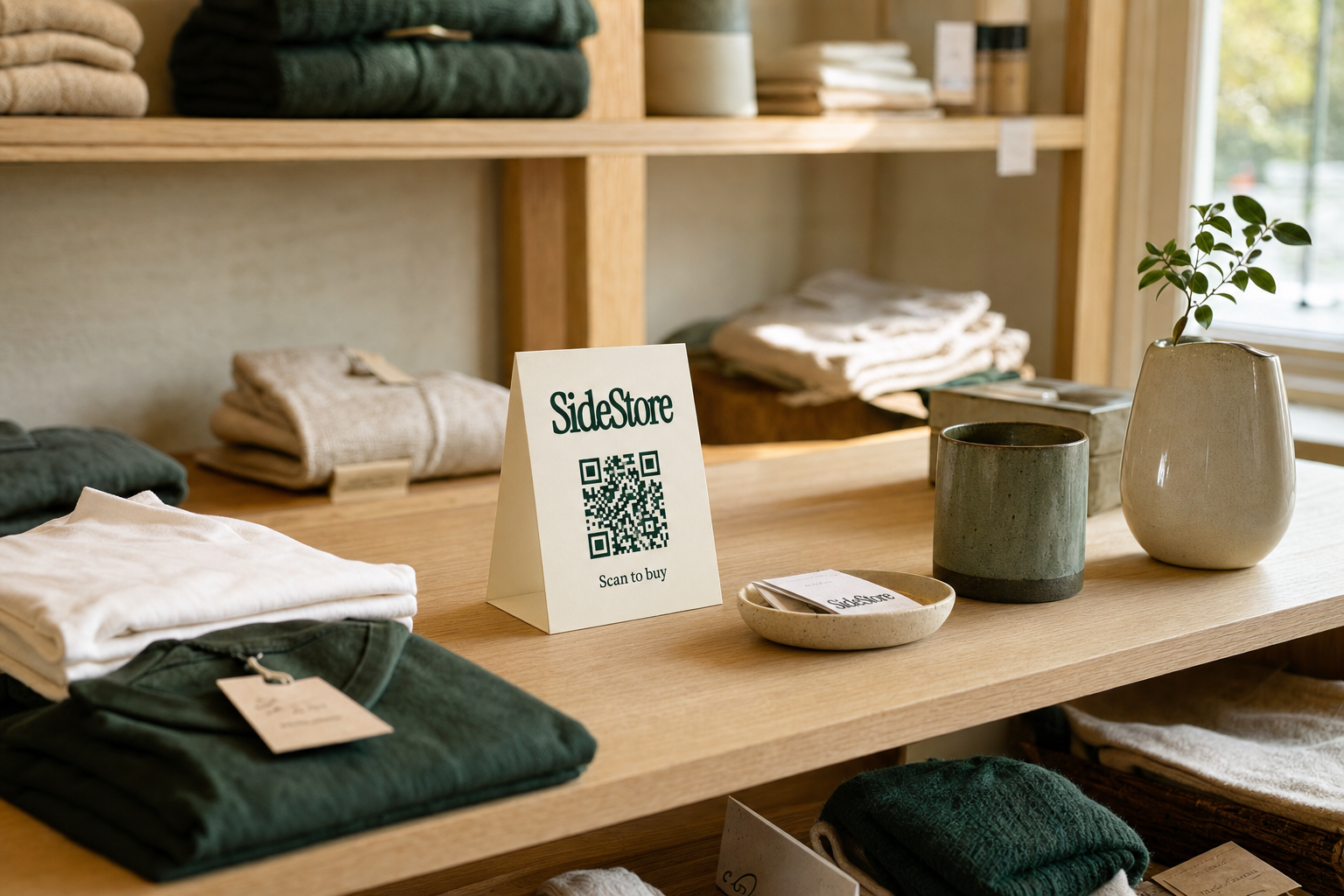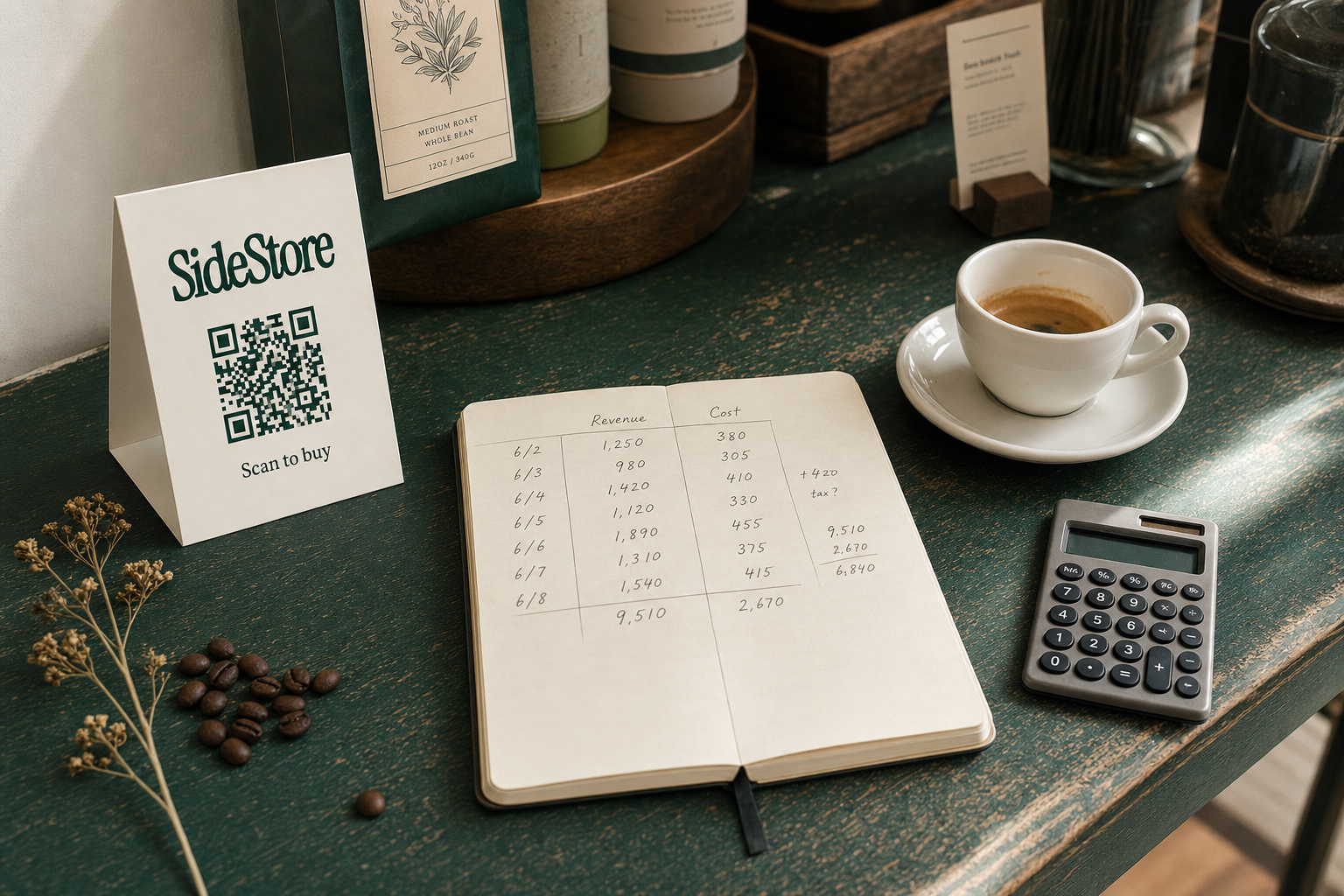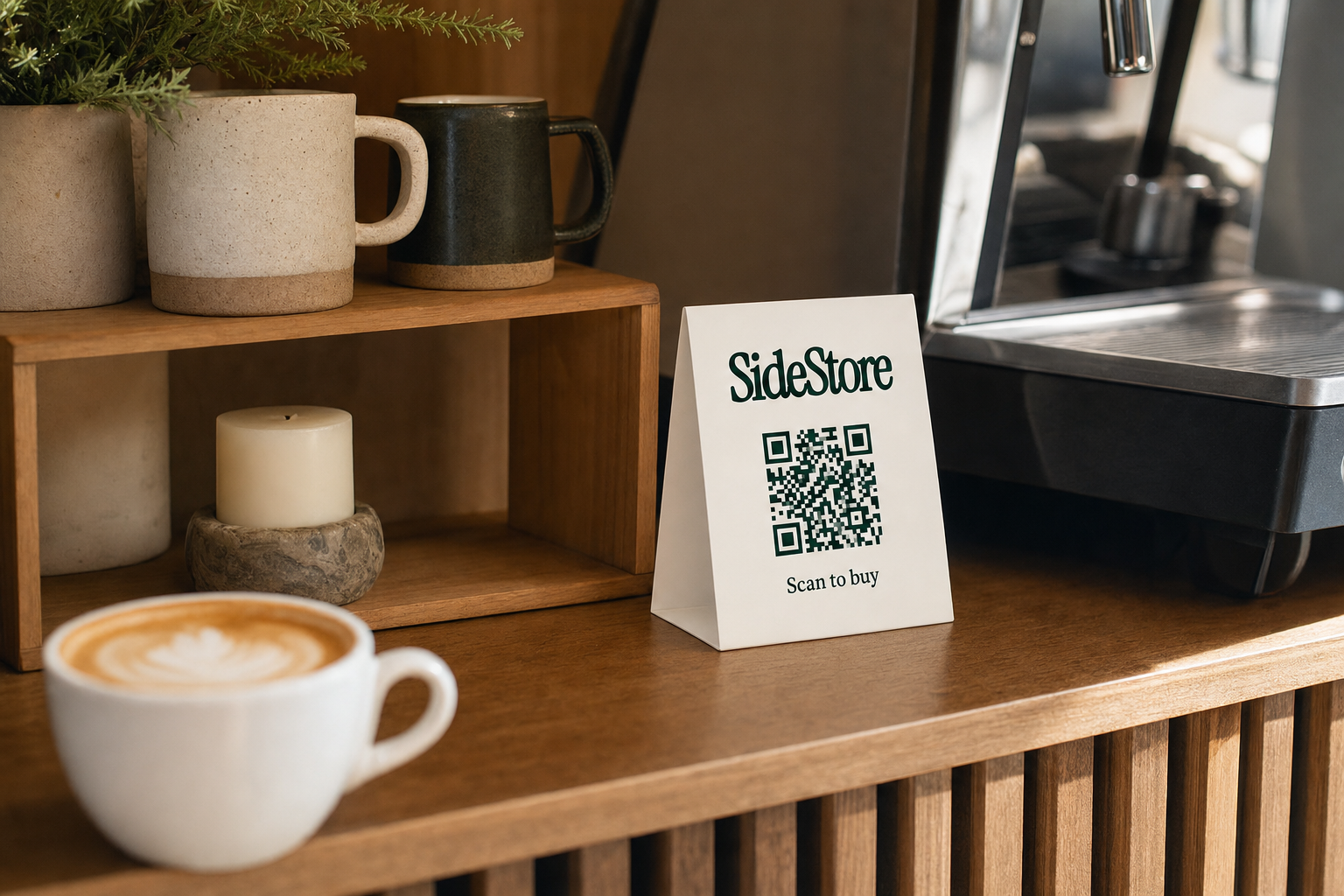
Coffee shop retail is selling physical products, beyond food and drink, directly from your café space. You turn customer dwell time and foot traffic into product sales. If you run a café and you have a spare shelf, a windowsill, or a counter corner, you already have a retail floor. The question is whether you're earning from it.
Done well, coffee shop retail adds a revenue line that carries no kitchen labour and no recipe complexity. A customer waiting for an espresso notices a hand-poured candle. They scan, pay, and leave with it. You earn a margin without changing your menu or staffing model. The products can come from your own buying decisions, or they can come from local makers on consignment, which means zero upfront cost and zero stock risk to you.
This article covers what sells, how to structure the retail model, and how consignment through the SideStore Retail Widget makes setup practical for a café that has never done retail before. If you want the full picture on what retail adds to your coffee shop profit margins, that context is worth reading alongside this.
Why Coffee Shops Are Natural Retail Spaces
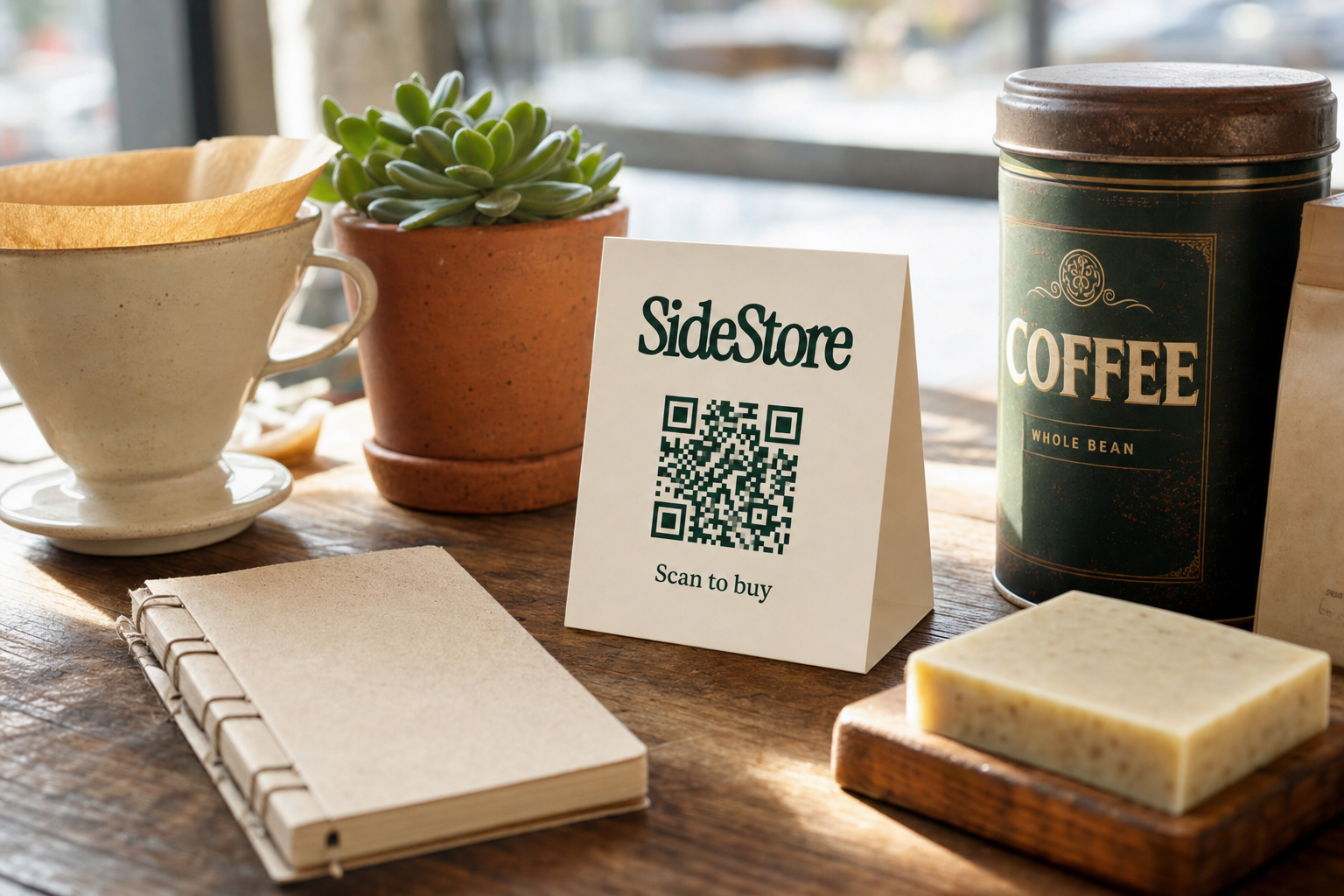
Coffee shops convert browsers into buyers more reliably than almost any other non-dedicated retail venue. Your customers already plan to stop, sit, and spend time there. That dwell time is the asset. A shopper in a boutique is already in buying mode. A café customer is in discovery mode, and that's often better.
Your space already provides what retailers pay significant lease premiums to manufacture: a warm, curated environment, ambient lighting, a reason to slow down, and a captive audience with disposable income in hand. The product display sits in a customer's sightline for the duration of a coffee. That might be twelve minutes or forty-five. During that time, an attractive product on a well-placed shelf does its own selling. No staff pitch required. No interruption to the service experience.
Your café's brand identity does merchandising work for you. If your space has a particular aesthetic, Scandinavian minimalism, earthy botanical, industrial-craft, products that fit that aesthetic feel curated, not random. Customers who trust your coffee taste are more likely to trust your product taste. That implied curation is something a standalone gift shop cannot easily replicate.
The commercial upside is real. Retail product sales run at higher gross margins than espresso drinks once the labour and ingredient cost of a beverage is stripped out. Exactly how that stacks up depends on your pricing and sourcing model, but the comparison is favourable. For a closer look at the underlying economics, see how much profit a coffee shop makes and the mechanics behind profit from a coffee shop.
What Sells in a Coffee Shop
The products that sell best in cafés fall into three tiers: impulse items customers grab without deliberation, considered purchases they weigh briefly, and gift-ready items they pick up for someone else.
Tier 1, Impulse: Small, low-price-point items. Lip balm, ceramic magnets, matchboxes, small print cards, branded cloth bags.
Tier 2, Considered: Mid-range items requiring a moment's thought. Hand-poured candles, small-batch preserves, illustrated notebooks, locally made soap, tea blends.
Tier 3, Gift-ready: Higher-price items bought with intent. Ceramic mugs, art prints, small houseplants, curated gift sets.
All three tiers have a place, but the volume comes from Tiers 1 and 2. Tier 3 items sell less frequently but at higher value and often with better margin for the host.
The consistent pattern: products with a clear local or artisan story sell better in a café environment than mass-produced equivalents at the same price point. Customers in a coffee shop are already buying into a story, the origin of the beans, the skill of the barista, the identity of the place. A product that extends that story ("made by a ceramicist two streets away") converts better than a generic equivalent.
Products that are consumable or perishable, small-batch hot sauce, flavoured salts, speciality teas, have the additional advantage of repeat purchase. A customer who bought the chilli oil once and loved it will come back for another. That loyalty loop is worth more than the margin on a single sale.
For a broader picture of how this plays out in a dedicated coffee retail context, coffee retail shop is a useful reference.
Avoid fragile, space-hungry, or high-maintenance items. A café is not a gallery. Products that require special handling, climate control, or constant staff attention will cost more in friction than they return in margin.
Consignment vs. Buying Wholesale: Which Model Fits a Café
For most cafés, consignment is the better-fit model for retail products. Buying wholesale means tying up cash, accepting stock risk, and making purchasing decisions before you know what your customers actually want. Consignment means a maker places products in your space and you earn a split only when something sells, no upfront outlay, no unsold stock problem.
Here is the comparison in plain terms:
| Model | Upfront cost | Stock risk | Admin effort | Typical host margin | Best for |
|---|---|---|---|---|---|
| Buy wholesale | High (purchase price paid upfront) | Full, you own unsold stock | Moderate (purchasing, reordering) | 30, 50% gross (varies) | Cafés with established retail demand and buying expertise |
| Consignment | Zero | None, unsold stock returns to maker | Low (especially with automated tools) | Typically 20, 40% of sale price | Cafés new to retail, or testing a product category |
| SideStore consignment | Zero | None | Very low (Retail Widget automates payouts and tracking) | Set per placement | Cafés wanting automated settlement and live stock data |
The wholesale model can deliver higher margin on a per-unit basis if you negotiate well and sell through reliably. But "selling through reliably" is the gamble. Buy fifty units of a locally made candle and sell thirty, and you're left managing dead stock that occupies shelf space, ties up cash, and requires a markdown decision.
Consignment removes that problem entirely. You host the product, you earn a split on each sale, and if a product does not move, the maker collects it. Your downside is limited to the shelf space you allocated.
The practical trade-off is margin. On consignment, your share of each sale is lower than your gross margin on a wholesale purchase because the maker retains a portion. Whether that trade-off makes sense depends on your sales velocity and risk appetite. For a low-volume café experimenting with retail for the first time, the consignment model is almost always the rational choice. For a high-traffic café with a proven bestseller, buying wholesale on that specific product line may eventually make sense.
To understand the full mechanics of the model, how consignment works and selling to consignment cover the detail.
How to Set Up Retail on Consignment in Your Café
Setting up consignment retail in your café takes five steps: identify the space, agree a placement with a maker, configure the Retail Widget, go live with scan-to-pay checkout, and monitor stock remotely. Each step is lighter than it sounds.
1. Identify your available space. A single shelf, a counter corner, or a windowsill ledge is enough to start. You do not need a dedicated retail zone. Measure what you have and decide how many product lines fit without cluttering the customer experience.
2. Find a maker and agree terms. Approach a local maker, artisan, or designer with a simple proposal: you host their products, they supply a set quantity, and you both earn a split when something sells. The split percentage is negotiable and agreed between you and the maker before anything goes live. Common structures vary, but the important thing is that both sides agree upfront and the Retail Widget records it so there is no ambiguity at payout time.
3. Set up the placement in the Retail Widget. The SideStore Retail Widget is the interface that handles the full placement: checkout (via scan-to-pay QR), live stock tracking, placement attribution, and automatic split payouts to you and the maker. You configure the product, the stock count, and the agreed split inside the Widget. That configuration becomes the live record of the placement.
4. Print and display the QR card. A maker can print the SideStore QR code card and attach it to their own product, or you can display a single SideStore card for all the products in your placement. Either way, the scan-to-pay QR is one function of the Retail Widget, it is the customer-facing checkout mechanism, not the whole system. For the precise mechanics, how the SideStore QR card works explains the flow.
5. Monitor and restock. The Retail Widget tracks live stock levels. When a product sells, the count updates. When stock runs low, you see it in the dashboard and can ask the maker to replenish. Payouts settle automatically, no end-of-month manual reconciliation.
The whole setup can go live quickly once the maker supplies the products and the placement is configured. For more detail on the host-side opportunity this creates, how cafés can make money from unused shelf space goes deeper on the numbers.
Display and Merchandising in a Small Space
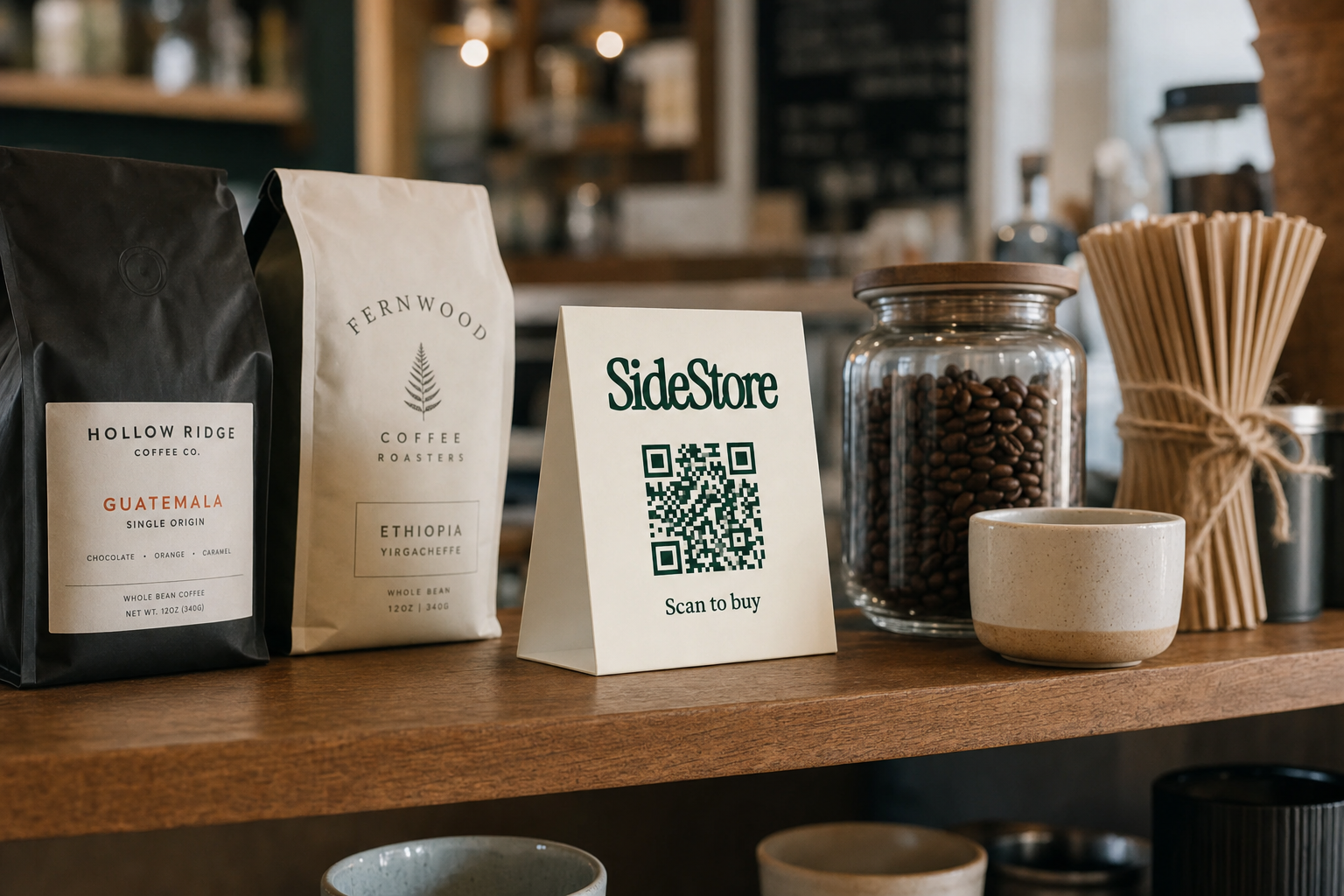
Good café retail merchandising comes down to four principles: placement at eyeline, editorial editing, clear pricing, and live stock management. Apply all four and a single shelf can outperform a badly managed rack of fifty products.
Eyeline placement. Products displayed at sitting eyeline height, roughly counter-level for standing customers, lower for those seated, attract the most attention. Avoid putting retail above head height or below knee height.
Edit ruthlessly. Three products displayed well beat twelve products displayed poorly. Overcrowding signals disorganisation. Restraint signals curation.
Price everything visibly. An unpriced product is a friction point. A customer who has to ask the price rarely completes the purchase. Clear, clean price labelling removes that friction instantly.
Monitor live stock. An empty slot where a product used to be is worse than no slot at all, it signals neglect. The Retail Widget's live stock tracking lets you see inventory levels remotely, so you can restock proactively rather than discovering an empty shelf during a busy service period.
Small spaces reward height and layering. A tiered stand or a simple riser can double your display capacity without claiming additional counter footprint. Natural materials, wood, linen, ceramic, tend to complement most café aesthetics and let the product remain the focus rather than the fixture.
For the full opportunity this represents, make money from unused shelf space frames the financial logic clearly.
Attracting Makers to Your Space
Finding makers to place products on consignment in your café is straightforward once you know where to look. The three most reliable sourcing channels are local craft markets, maker communities online (Instagram, Etsy seller groups, local Facebook maker groups), and direct outreach to makers whose work already fits your café's aesthetic.
Local markets and fairs. Walk a weekend market and approach makers whose products you could see on your shelf. They are already selling direct-to-consumer and understand the product-buyer relationship.
Online maker communities. Search Instagram by location plus product type. A maker selling hand-poured candles in your city is easy to find and often looking for offline distribution.
Direct aesthetic match. Identify brands or makers whose visual identity already matches your café's. Cold outreach with a specific compliment and a concrete offer converts better than a general enquiry.
Your pitch is simple: you have shelf space, foot traffic, and no upfront cost to the maker. Their products go live in a real-world venue without them having to manage a market stall or open a shop. The Retail Widget handles split payouts automatically, so there is no monthly admin burden on either side, the maker receives their share without chasing an invoice.
That combination, physical distribution, zero setup cost, automated settlement, is genuinely useful to independent makers who are looking to sell products without opening a retail store or who are exploring alternatives to weekend markets. Your café becomes part of their distribution network.
The Same Model Works Beyond the Café
The consignment retail model you run in a café works in any space with foot traffic and available surface area. Hotels, bed and breakfasts, and boutiques all have the same core asset: customers who dwell, browse, and spend, and spaces that currently earn nothing from their shelves.
If you operate more than one venue, or know operators in adjacent categories, the logic transfers directly. How hotels can turn lobby space into retail revenue, how bed and breakfasts can make money from a small retail corner, and how boutique shops can add local products without buying inventory cover each venue type in detail. The Retail Widget, the consignment structure, and the split payout mechanics are the same across all of them.
Start With One Shelf
The barrier to starting coffee shop retail on consignment is lower than most café owners expect. You do not need a retail licence, a new POS system, or a buying budget. You need one shelf, one maker, and a configured placement in the Retail Widget.
The model is clean: a maker supplies products, you host them, customers scan and pay, and the Retail Widget splits the revenue automatically. No stock risk for you, no admin burden for either side, and no margin squeeze from wholesale purchasing decisions made before you knew what would sell.
If you are new to retail entirely, managing boutique inventory and the baseline economics covered in average coffee shop profit give useful context before you start. But the concrete first action is simple: identify a shelf in your café, find one local maker whose products fit your aesthetic, and configure the placement today.
Build a consignment network without opening a store of your own.