Starting an online boutique without inventory means building a retail business around products you never physically stock yourself. Instead of buying goods upfront and warehousing them, you either source on demand, sell through a third-party fulfillment partner, or place your own handmade products in merchant spaces on consignment. All three paths let you sell products without opening a retail store.
The right model depends on what you sell. If you make your own products, dropshipping and print-on-demand are largely irrelevant. You need a distribution model that handles physical handmade goods. Consignment placement, which puts your products into cafes, boutiques, hotels, and high-traffic retailers without requiring you to rent a storefront, is often the most practical route.
This article covers each model honestly. What it costs. What it risks. Where it breaks down. By the end, you will know which path fits your situation and how to take the first concrete step.
What "No Inventory" Actually Means for a Boutique
The phrase "no inventory" covers three distinct situations. They are not interchangeable, and conflating them leads to the wrong decision.
You hold stock, but not in a warehouse you pay for. This is consignment placement. You produce your goods, then place them in a merchant's space. The merchant holds the physical stock on your behalf. You do not carry warehousing costs, but you do carry the production cost until the product sells.
You never touch the product at all. Dropshipping and wholesale sourcing work this way. A supplier holds the stock, ships directly to the customer, and you never see the goods. This works for curated or branded resale, but it is almost impossible to apply to handmade or one-of-a-kind products.
You produce only when an order arrives. Print-on-demand sits here. A platform prints and ships your design on a product after the sale. There is no unsold stock, but there is no handmade quality either.
Understanding how consignment works matters because consignment is the one "no inventory" path that suits handmade goods and physical distribution simultaneously. It is also the only model where you can access real-world retail foot traffic without a lease. For a deeper look at the term itself, see consignment meaning.
The Main Models: Dropshipping, Print-on-Demand, and Consignment Placement
Three inventory-free models dominate this space, each suited to a different kind of seller.
| Model | Who holds stock | When you get paid | Suitable for handmade goods | Setup effort | Key risk |
|---|---|---|---|---|---|
| Dropshipping | Third-party supplier | After order ships | Rarely | Medium (platform + supplier setup) | Supplier quality, long shipping times |
| Print-on-demand | Print platform | After order ships | No | Low (design upload) | Low margins, no craft differentiation |
| Consignment placement | Merchant venue holds your stock | When product sells in-venue | Yes | Low-to-medium (product + placement) | Slow venues, unsold stock returned |
For physical makers, the critical distinction is sharp. Dropshipping and print-on-demand require no production on your part, which also means they offer no room for handcrafted value. A buyer cannot feel the weight of your ceramic glaze or the hand-stitching on your textile through a dropship listing. Consignment placement keeps your physical product in front of buyers who can touch, examine, and decide in person.
That in-person quality also changes how consignment converts. A customer browsing a cafe or boutique encounters your work in a context they already trust. That ambient endorsement is something a product page cannot replicate.
If you are looking to move beyond market stalls and pop-ups without committing to a lease, consignment placement is the most direct path. See the full breakdown of alternatives to weekend markets for a wider view.
Consignment Placement: Your Products in Real Venues, No Lease Required
Consignment placement is an arrangement where you provide your products to a merchant venue and get paid only when those products sell. The merchant takes a percentage of the sale as a hosting fee. You carry no rent, no lease, and no fixed monthly cost for the shelf space.
The venue types most receptive to this model are independent cafes, boutique clothing and gift shops, bed and breakfasts, hotel lobbies, wellness studios, and specialty food retailers. They have something in common: foot traffic, surfaces or shelves with idle space, and a desire to offer something distinctive without buying stock themselves.
The distributed consignment network model takes this one step further. Instead of one placement in one venue, you place products across multiple merchant spaces simultaneously. Your boutique is not a single storefront. It is ten placements in ten venues across a city, or across several cities, each one stocked with your products and each one earning independently.
Most "online boutique without inventory" guides miss this entirely. They focus on dropship platforms and digital storefronts. They do not mention that placing products in a coffee shop, a hotel lobby, a bed and breakfast, or a boutique adding local products on consignment is a legitimate, scalable distribution strategy.
You do not need a storefront. You need placements.
How SideStore's Retail Widget Activates Each Placement
Placing products in a venue is straightforward. Managing those placements across multiple venues without losing track of stock, sales, or payouts is where most makers hit a wall. The SideStore Retail Widget solves that problem.
The Retail Widget is an end-to-end consignment management interface. It handles the full lifecycle of a placement: modeling your product, activating the placement in a merchant's space, tracking live stock levels, processing checkout, attributing sales to the correct venue, and splitting the payout automatically between you and the merchant. It is not a QR code tool with some extras bolted on. The QR checkout is one function within the Widget, not the product itself.
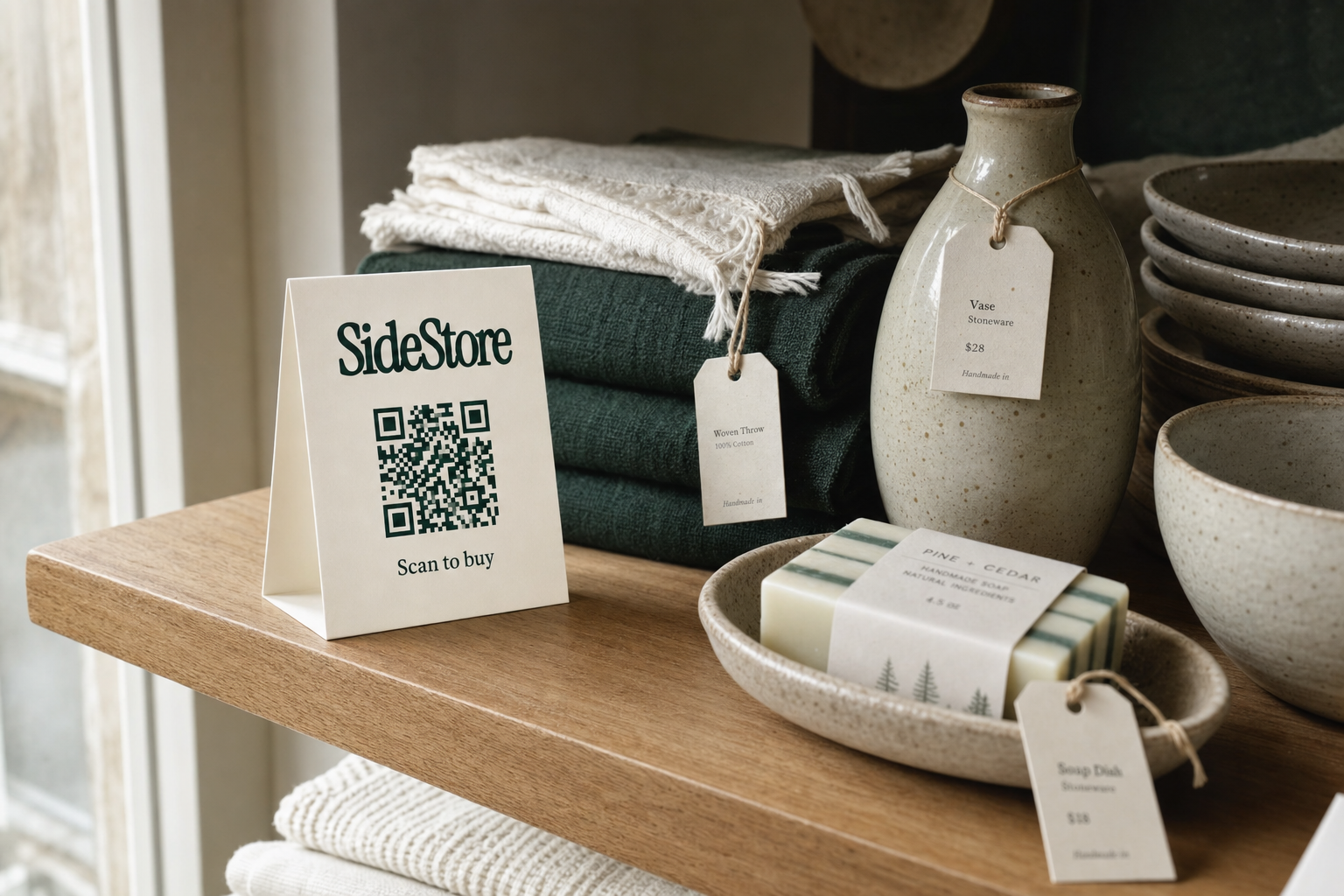
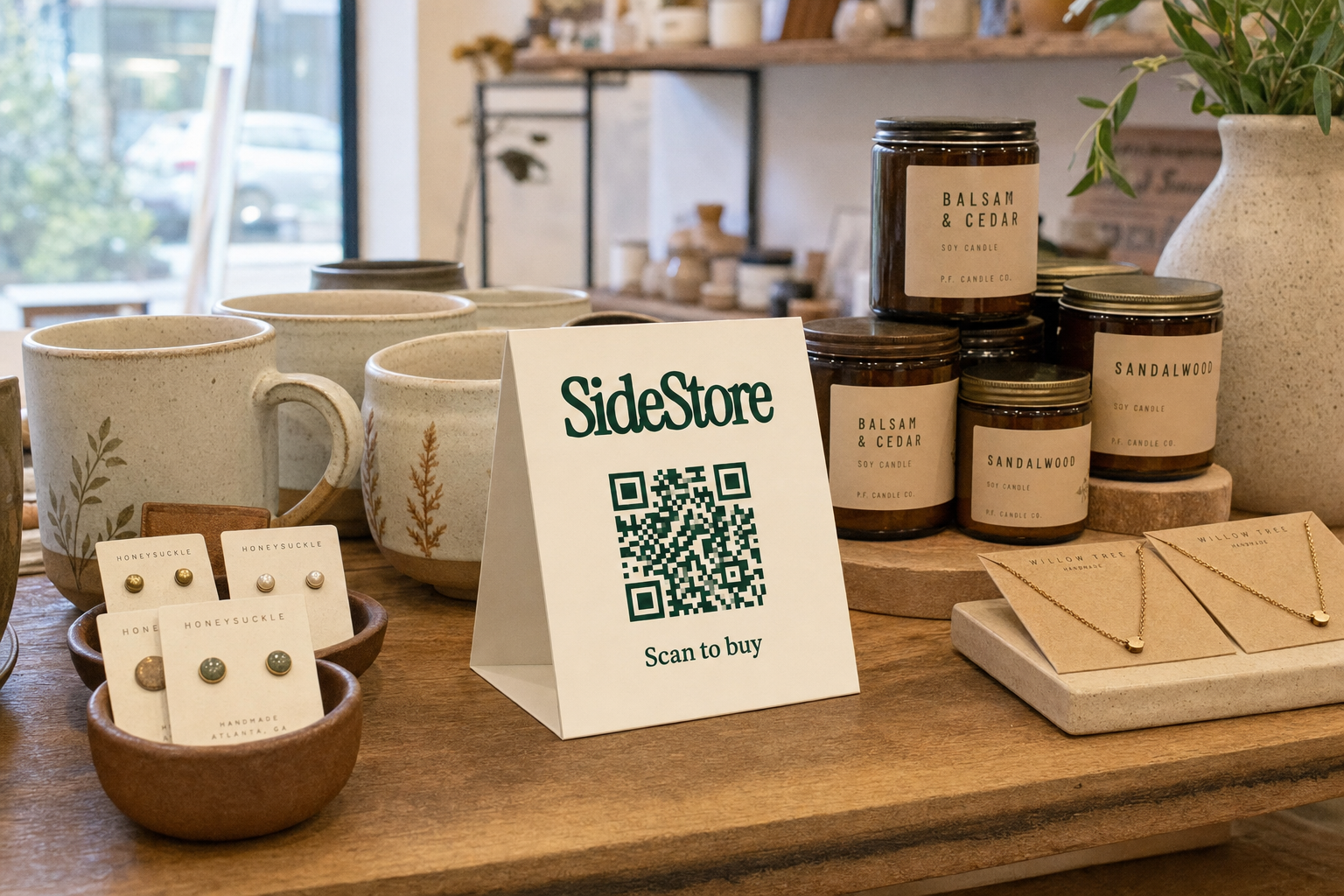
Here is what that looks like in practice. When a customer in a cafe sees your product and wants to buy it, they scan the SideStore QR card displayed at the placement. The Retail Widget processes the transaction, records the sale against that specific venue, adjusts your live stock count, and calculates the split payout. You see the sale in your dashboard. The merchant receives their hosting percentage automatically.
You can learn more about how the SideStore QR card works and how merchants earn from idle shelf space through the same system.
What SideStore does not do matters too: it does not manufacture your products, arrange logistics for restocking, or guarantee that any given venue will generate sales. The platform activates and manages placements. The rest, producing quality goods and choosing venues with genuine foot traffic, is on you. That is an honest constraint worth naming.
Step by Step: Starting Your Consignment Boutique Without Inventory Risk
Starting a consignment boutique is a sequence of concrete decisions, not a single launch moment.
1. Define your product range clearly. Identify which products you will place on consignment. Keep the range tight at first. Two or three product types you can produce consistently are better than eight variations you cannot restock reliably.
2. Set your pricing to absorb the consignment split. A typical consignment split gives the host venue somewhere between 20% and 40% of the retail price, though actual splits vary by product category, venue type, and what you negotiate. Your retail price must cover your production cost, the host's percentage, and leave you a workable margin. Calculate this before you approach any venue.
3. Research the consignment model in depth. Read how to sell handmade products in physical stores on consignment before you sign anything. Understand return conditions, minimum placement durations, and who is responsible for damaged stock.
4. Identify your first placement targets. Start with venues you already visit or know. A cafe you use regularly is a better first conversation than a boutique you have never entered. See how cafes approach shelf-space hosting and what motivates high-traffic retailers with idle shelf space to host makers.
5. Pitch with a sample, not a brochure. Bring the actual product. Merchants decide faster when they can hold it.
6. Set up SideStore for your first placement. Configure the Retail Widget for the venue. Print the QR card. Confirm the stock level is accurate before you leave.
7. Monitor performance over the first four to six weeks. Track sell-through rate, not just total sales. A venue with five units sold out of five is a better signal than a venue with two units sold out of twenty.
8. Restock promptly when stock runs low. Slow restocking kills momentum in a placement.
Finding Merchant Partners Who Will Say Yes
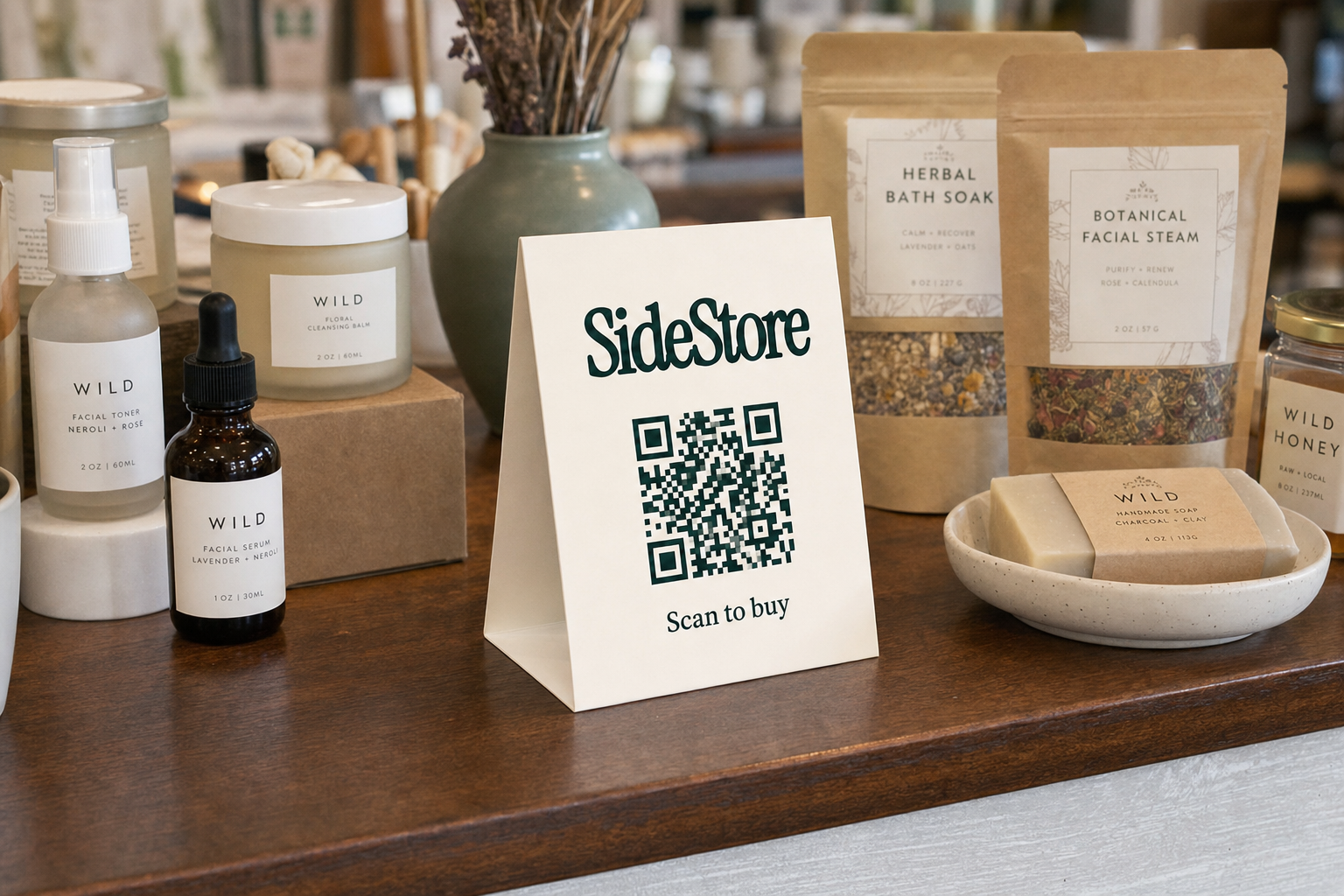
The easiest merchant partners to approach are the ones who already think of their space as a place people linger. Cafes and coffee shops are typically the most receptive: their customers sit, browse, and are already in a spending mindset. Independent gift shops and design boutiques come next. Bed and breakfasts are strong candidates because their guests actively want to buy local. Hotel lobbies vary more widely by brand and management, but independent and boutique hotels are often open to the conversation.
Approach in this order: cafes first, independent gift or lifestyle boutiques second, bed and breakfasts third, and hotel lobbies fourth.
When you pitch, keep it short and lead with the merchant's benefit. A working pitch looks like this:
"I make [product type] locally and I'm looking for a few venues to host them on consignment. You keep a percentage of every sale, there's no stock to buy, and I handle restocking. I'd like to leave a sample so you can see the product in your space."
That is it. Merchants who are interested will ask follow-up questions. Merchants who are not will say so quickly, and that is fine. Expect some rejections. Bring a sample every time, because it shortens the decision from days to minutes.
Scaling From One Placement to a Distributed Boutique
One successful placement is proof of concept. Scaling means adding placements, not adding overhead. The entire logic of the consignment model is that your cost base stays flat while your distribution footprint grows.
Before you add a second placement, check three signals from your first: sell-through rate (what percentage of stocked units sold within a set period), restock frequency (are you running out before you can restock?), and venue feedback (is the merchant actively recommending your product to customers?). All three positive is your signal to expand.
A distributed boutique of six to twelve well-chosen placements, each with consistent sell-through, is a meaningful retail presence without a single lease or a single set of fixed monthly costs. It is also genuinely scalable through SideStore's dashboard because each placement is tracked independently.
Be honest about the model's ceiling too. Consignment placement depends on foot traffic you do not control. A venue that goes quiet, closes, or changes its layout can reduce your sales without warning. Diversifying across venue types and neighborhoods is the practical hedge.
Frequently Asked Questions
Do I need a website to start an online boutique without inventory?
Not necessarily, especially not for consignment placement. A website helps with brand credibility and can support online orders alongside your physical placements, but your first consignment placement does not require one. Many makers start with a simple social profile and a SideStore dashboard, then build a website once they have proven sales.
What is the difference between consignment and dropshipping?
Consignment means you produce the goods and a merchant venue hosts them in their physical space. You get paid when a customer buys in that venue, and the merchant takes a hosting percentage. Dropshipping means a third-party supplier holds stock and ships directly to an online customer on your behalf. You never produce or touch the product. Consignment suits handmade goods. Dropshipping does not.
How much does a typical consignment split give the maker?
A common range is 60% to 80% to the maker, with 20% to 40% going to the host venue. These figures vary by product type, venue, and what you negotiate, so treat them as a starting benchmark, not a guarantee.
Can I use SideStore if I sell online already?
Yes. SideStore manages your physical consignment placements independently of your online store. Many makers run both channels simultaneously, with their website or marketplace listings handling digital sales and SideStore handling in-venue placements.
Your First Placement Is the First Store
You do not need to wait until you have a website, a warehouse, or a retail lease to start selling. Your first consignment placement is your first store. Identify one venue, price your products to absorb the split, bring a sample, and set up the Retail Widget when they say yes.
Sell physical products without a storefront by building placements, not premises.
Build a consignment network without opening a store of your own.