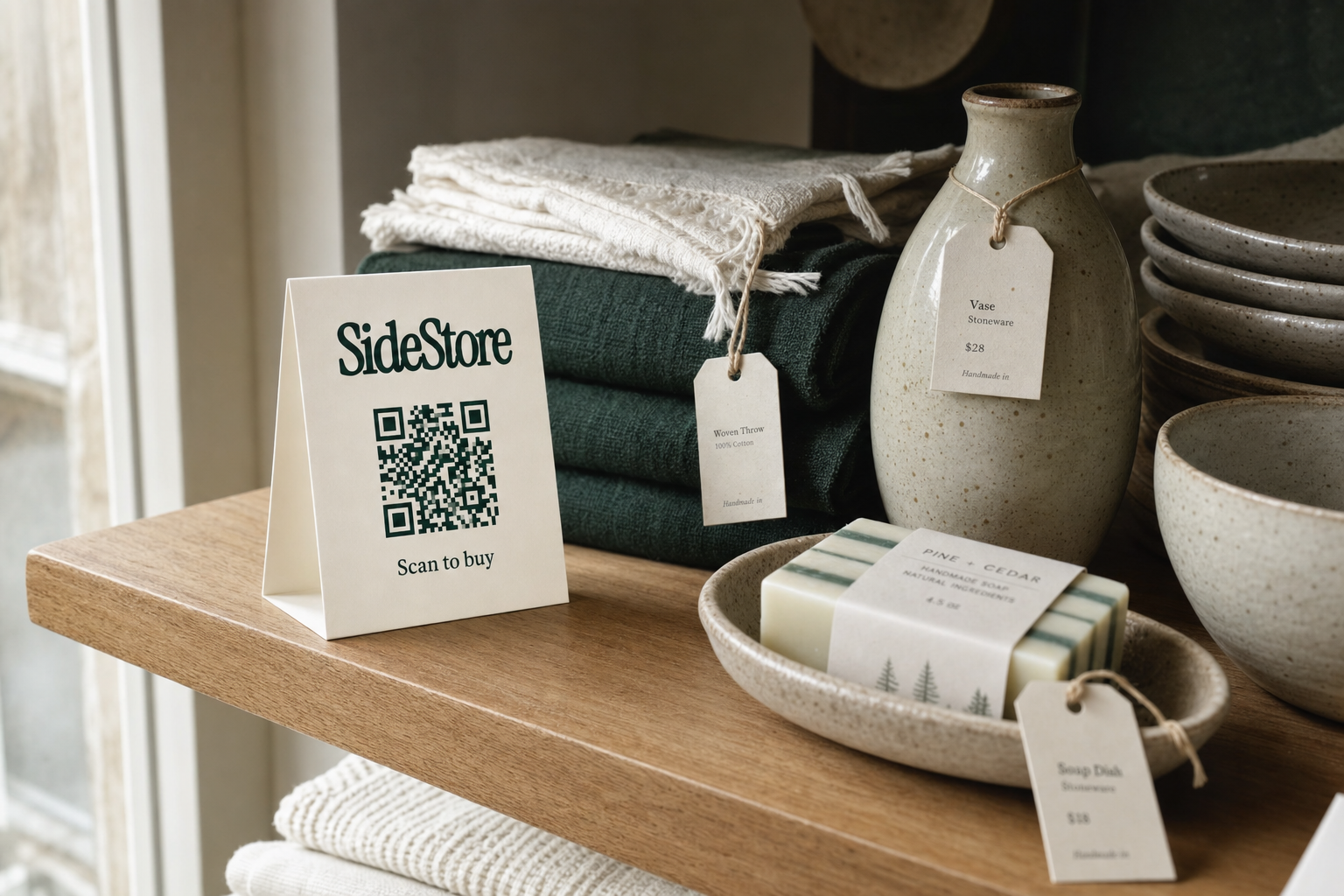
Consignment selling is an arrangement where a maker places products in a merchant's space and gets paid only when those products sell. No upfront cost to the host. No inventory risk on either side. If you want to understand how it works, here is the short version: the maker supplies stock, the merchant provides shelf space and foot traffic, and a consignment agreement sets out the split and the terms. Neither party hands over cash before a sale happens.
That low-friction entry is why consignment remains one of the most practical routes for independent makers who want offline distribution without the cost of running a store.
The model suits independent artisans, designers, and small-batch producers who need retail presence but cannot justify a lease. It suits merchants who have idle shelf space and want to offer something interesting to their customers without buying inventory. For a fuller breakdown of how the mechanics work in practice, read the guide to selling on consignment or see how other makers sell products without opening a retail store.
How Consignment Selling Works
When a maker places products on consignment, they hand physical stock to a merchant, that stock is displayed for sale, and the maker receives their share of the revenue only after a customer buys. Nothing changes hands financially until the point of sale. Here is the lifecycle, step by step.
1. Reach an agreement. The maker and merchant sign a consignment agreement before any stock moves. This document must specify the revenue split, the minimum display period, the process for returning unsold stock, who bears the cost of damage or theft, and the payment schedule.
2. Deliver and display stock. The maker brings a defined quantity of products to the venue and hands over a written inventory list. The merchant displays the products in an agreed location.
3. Track sales. Under a manual system, the merchant logs each sale and reports back to the maker on a fixed schedule, weekly or monthly. With a tool like the SideStore Retail Widget, stock levels update automatically after each scan-to-pay transaction, removing the need for manual reconciliation.
4. Settle payment. The merchant remits the maker's share according to the agreed schedule. Automated split payouts, available through modern consignment platforms, eliminate the remittance friction that makes manual settlement error-prone.
5. Replenish or retrieve. When stock runs low or the display period ends, the maker tops up inventory or collects unsold items. Any unsold stock remains the maker's property throughout.
The consignment agreement is not optional. A handshake arrangement leaves both parties exposed when products go missing or a venue closes. For a practical walkthrough of the model, see the guide to selling through consignment. For details on how checkout can work at the point of sale without a staffed till, read how the SideStore QR card activates checkout.
Consignment Splits, Terms, and What to Negotiate
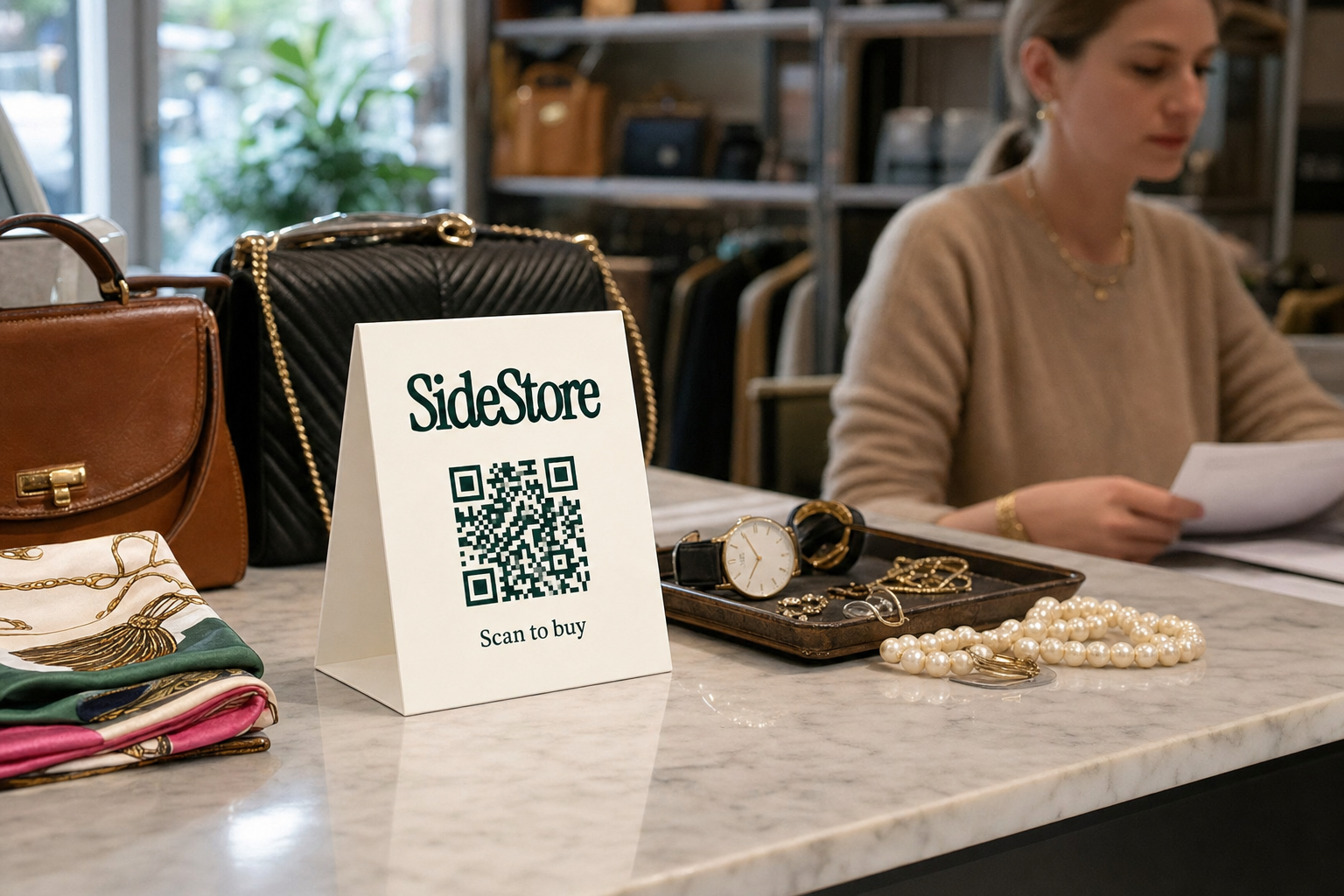
A typical consignment split gives the maker 50, 70% of the sale price and the merchant 30, 50%, but these figures are a convention, not a rule. What moves the split is negotiating power, venue foot traffic, product price point, and how much merchandising effort the merchant provides.
Several things push the merchant's share higher: a high-traffic location, display fixtures the merchant supplies, and staff who actively recommend the product. Several things push it lower: low-maintenance products, self-explanatory packaging, and a maker bringing multiple product lines that fill a full display.
Five terms every consignment agreement must cover:
- Revenue split. The exact percentage each party receives per sale, stated as a number, not a range.
- Display period. The minimum time the merchant commits to displaying the products before requesting removal.
- Inventory ownership. A clear statement that unsold stock remains the maker's property at all times.
- Damage and theft liability. Which party absorbs the cost if a product is damaged in-store or stolen.
- Payment schedule. The exact date or frequency on which the merchant remits the maker's share.
One practical negotiating lever for makers: offer a higher merchant percentage in exchange for a guaranteed minimum display period and a fixed shelf position. Predictable placement is worth more than an extra few percentage points on a sale.
On the payment side, automated split payouts remove the remittance friction entirely. When a customer scans and pays through the Retail Widget, each party's share is calculated and allocated at the point of sale, with no end-of-month chasing required. For a grounding in consignment basics for makers, the linked article covers the fundamentals.
Consignment Selling: Trade-Offs at a Glance
Each party gains something real from consignment selling and gives something up. The maker gets distribution without a lease; the merchant gets product without purchasing inventory. But each side also carries a specific risk that is worth naming before you sign anything.
| Party | What they gain | What they give up | Key risk |
|---|---|---|---|
| Maker | Offline retail presence with no upfront cost; products in front of foot traffic they do not own | Cash flow certainty; products leave their hands before payment | Unsold stock sitting idle or returned damaged |
| Merchant | Revenue from idle shelf space; no inventory cost; fresh, curated product for customers | A share of the sale price; minor admin to manage stock and remittance | Slow-selling products occupying prime display space |
| Both | A low-commitment way to test a working relationship before deeper terms | Full margin; the simplicity of a single-party transaction | Disputes if the consignment agreement is vague or unsigned |
Consignment is the right model when both parties want to test the relationship before committing to wholesale terms, and when the maker cannot absorb the cash-flow hit of selling on invoice. It is the wrong model when the merchant expects guaranteed sell-through or when the maker needs revenue on a fixed schedule regardless of sales.
For makers weighing up their options beyond the market stall, read alternatives to weekend markets. For merchants assessing whether consignment fits their space, how cafes earn from unused shelf space covers the host side in detail.
Where to Place Products on Consignment
The best venue for a consignment placement is one where the customer who walks in already wants what you make. Before approaching any merchant, ask two questions: Does their customer base overlap with my buyer? Does my product fit the physical and aesthetic context of the space?
Four venue types that work well for consignment:
Coffee shops and cafes. Dwell time is high, customers are in a browsing mindset, and counter and shelf space near the till converts well for small, giftable products. See coffee shop retail placements for specifics.
Boutique hotels and hotel lobbies. Guests want locally made souvenirs and useful travel items; the captive audience and premium price tolerance make hotels strong venues for craft and design products. Read more about hotel lobby consignment placements.
Bed-and-breakfasts. Smaller scale than hotels, but with a personal, curated atmosphere that suits artisan products; hosts often become genuine advocates for makers they like. The bed-and-breakfast retail corner article covers setup in detail.
Independent boutiques and lifestyle retailers. Existing retail shops with aligned aesthetics give makers immediate access to a pre-qualified customer base and an experienced selling environment.
Beyond venue type, placement attribution matters. Modern consignment tools track which venue is driving sales, so you can see exactly which placements are performing and which are not. Without that data, you are restocking blind.
Scaling Consignment: From One Venue to a Distributed Network
One placement is manageable with a notebook and a monthly check-in call. Five placements across three towns is where manual tracking starts to break down. At ten placements, the admin load of chasing stock counts, reconciling sales figures, and remitting individual payments can consume more time than making the products themselves.
The problem compounds in a specific way. Each new venue adds a separate tracking sheet, a separate payment relationship, and a separate risk of miscounting. Manual systems do not scale. They just get more fragile as the network grows.
The Retail Widget addresses this directly. It is the interface that lets a maker model, place, and manage a product on consignment, covering live stock tracking, a scan-to-pay QR checkout, automatic split settlement, and placement attribution, all from a single dashboard. The QR checkout is one function of the Retail Widget, not the whole product: the Widget handles the full consignment lifecycle, from placement setup to post-sale settlement. A customer scanning a SideStore QR card at a cafe in one city triggers the same stock update and split calculation as a scan in a hotel lobby in another.
That architecture is what makes a distributed consignment network viable for a single maker without staff. Each placement stays live, attributed, and settled automatically, while the maker manages everything from one place.
For makers thinking about distribution without a warehouse, the guides on selling without holding inventory and selling without a retail store cover adjacent ground.
Consignment Selling vs Wholesale: Which Model Fits You?
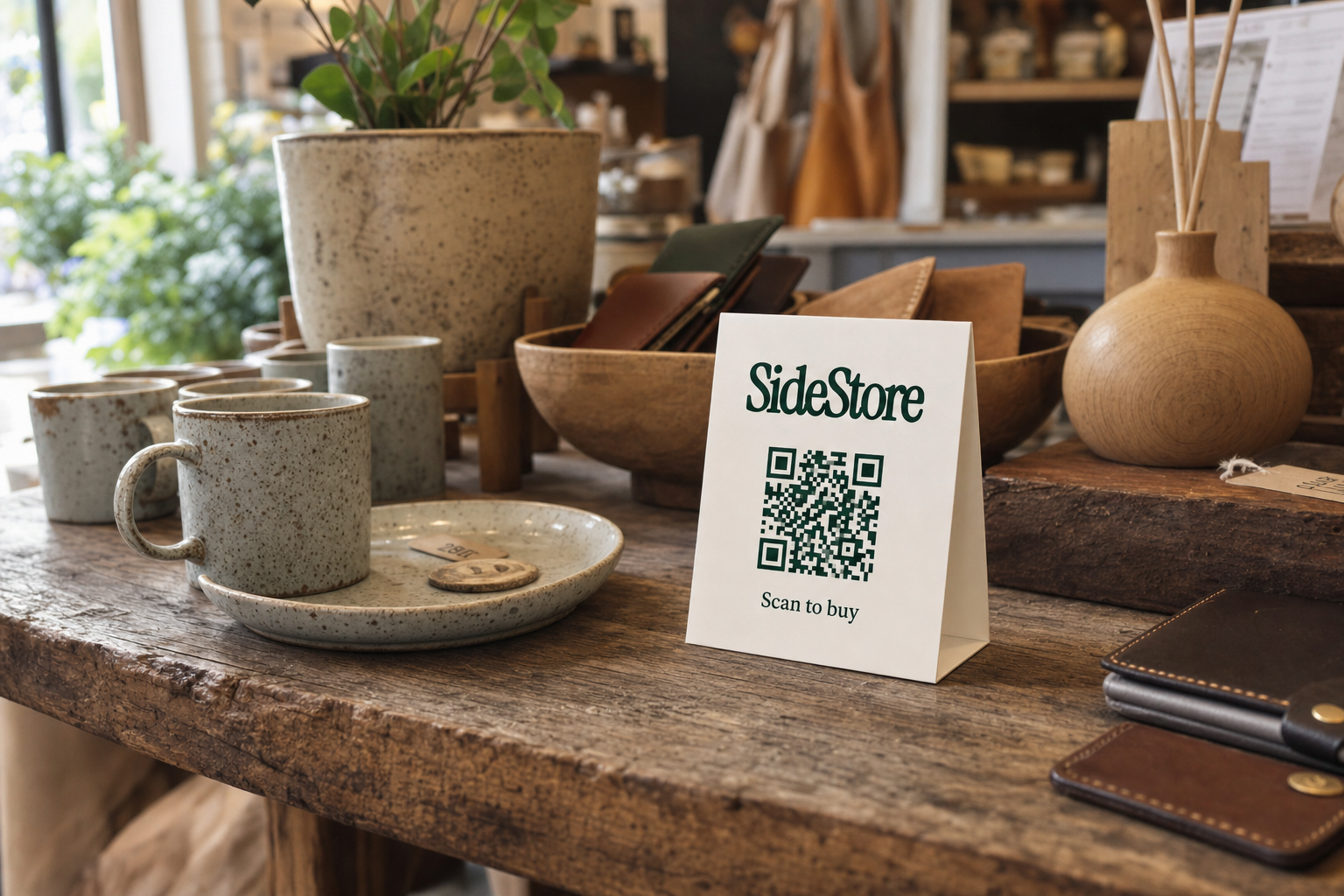
Choose consignment when you are approaching a merchant for the first time and neither party wants to take on financial risk. Choose wholesale when you have proven sell-through data and the merchant is ready to commit to purchasing stock upfront.
| Dimension | Consignment | Wholesale |
|---|---|---|
| Upfront cost to merchant | None | Full purchase price of stock |
| Maker cash-flow timing | After each sale | On invoice (usually 30, 60 days) |
| Stock risk | Stays with the maker | Transfers to the merchant at purchase |
| Margin per unit | Lower (split with merchant) | Higher (maker sets wholesale price) |
| Best for | New merchant relationships; testing demand in a new venue | Proven products; merchants who want full control of pricing |
The decision rule is simple: if you are walking into a merchant space cold, consignment is the easier door. It removes the merchant's objection that they might be left with unsold stock. Once you have three months of sell-through data from a consignment placement, you are in a much stronger position to propose wholesale terms and negotiate from a place of evidence.
For makers considering boutique wholesale as a next step, the boutique inventory purchasing article covers how that model works from the retailer's side.
Making Consignment Work: Practical Advice for Makers
The difference between a consignment placement that sells steadily and one that gathers dust is almost always preparation and follow-through, not luck. Product quality matters, but so does how you set up the placement and maintain it.
Five things that separate placements that sell from ones that sit:
Choose venues where your buyer already shops. A beautiful candle placed in a hardware store will not sell; placed in a hotel lobby or a lifestyle cafe, the same candle finds its customer naturally.
Write clear, self-contained product labels. A customer browsing without a sales assistant needs the product name, price, and one-line reason to buy, printed on the product or its packaging, not tucked away on a separate sheet.
Monitor stock levels and replenish promptly. An empty shelf earns nothing; live stock tracking via the Retail Widget makes this automatic, alerting you before a placement runs dry rather than after.
Visit each placement in person, at least once a quarter. Check the display position, dust the products if needed, and build a working relationship with the merchant. Merchants who like the maker tend to recommend the product.
Set a minimum quantity before you place. Arriving with three units looks like an afterthought; arriving with a full, styled display signals that you are serious and gives the placement room to perform.
For makers approaching distribution without the overhead of a warehouse or store, the guide to going to market without holding inventory covers related ground.
Start with One Placement
The right first step is straightforward: identify one venue whose customers match your buyer, approach the owner with a clear consignment proposal, and place a small quantity of stock with a signed agreement in hand. That single placement teaches you more than any plan written in advance.
Consignment selling gives independent makers offline distribution with no upfront cost and no store of their own. The model works because neither party takes on financial risk before a sale happens, and the Retail Widget, SideStore's infrastructure for live stock tracking, scan-to-pay checkout, and automatic split settlement, removes the admin friction that used to make multi-venue consignment impractical.
Once you have one placement running, the path to a second and a third is the same process, now informed by real sell-through data. Read how consignment selling works in practice for a step-by-step foundation, or browse cafes with idle shelf space to find the kind of merchant who is already looking for makers.
Build a consignment network without opening a store of your own.